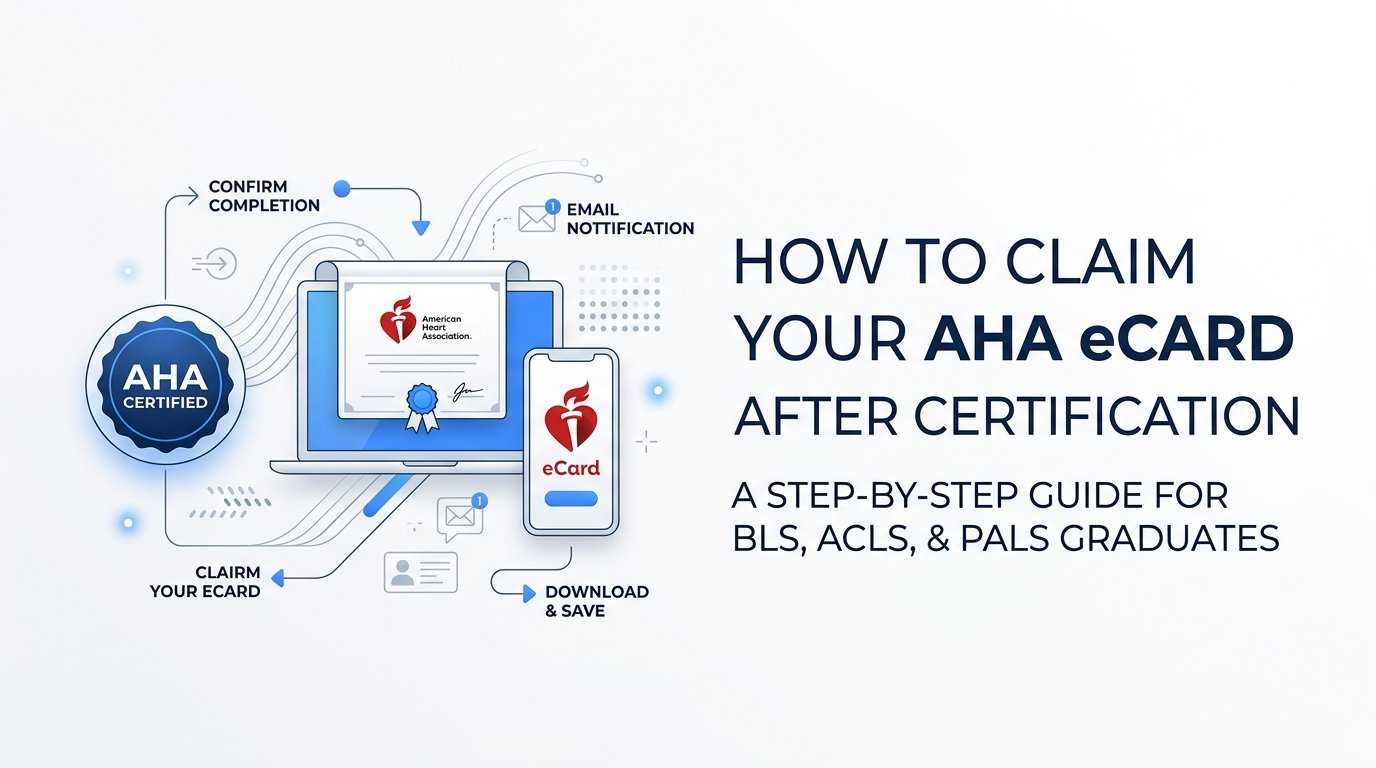
Picture this: you're a nurse renewing your BLS certification before your hospital's deadline, or a parent who just signed up for a CPR course after a health scare in the family. You show up, complete the class, and walk away with a card. But a few weeks later, your employer's credentialing department flags it. The card isn't valid. The instructor wasn't authorized to issue it.
This scenario plays out more often than most people realize. In a world where CPR and emergency training courses are advertised everywhere, from community centers to online platforms, the credential behind the instructor matters just as much as the course itself. Knowing how to perform chest compressions is one thing. Knowing that the person teaching you is held to a verified, evidence-based standard is another.
American Heart Association certified instructors are not simply people who know CPR. They hold a separate, more rigorous credential that authorizes them to teach AHA courses and issue the course completion cards that hospitals, clinics, and licensing boards recognize. This article breaks down exactly what that credential means, how instructors earn it, what it means for the quality of your training, and how to find an instructor you can actually trust.
The Credential Behind the Course
There is a distinction that trips up a lot of people when they start searching for certification courses, and it is worth getting clear on before anything else. Being a certified provider is not the same thing as being a certified instructor.
A certified provider is someone who has completed an AHA course, such as BLS for Healthcare Providers or Heartsaver CPR/AED, and holds a course completion card as a result. That card means they demonstrated the required skills and knowledge during training. It does not mean they are authorized to teach anyone else or issue cards to others.
An American Heart Association certified instructor is something entirely different. This person has gone through a separate credentialing process specifically designed to qualify them to deliver AHA curriculum, evaluate student performance, and issue official AHA course completion cards. The instructor credential is not a natural extension of completing a course. It is a distinct achievement with its own requirements, oversight, and renewal obligations.
Here is another layer that often gets overlooked: AHA instructors do not operate independently. They must be affiliated with an AHA-authorized Training Center. Training Centers are organizations that have been vetted and authorized by the AHA to oversee instructors, maintain curriculum standards, and ensure that courses are delivered correctly. Think of the Training Center as the organizational backbone that gives an instructor's credential its legitimacy.
This structure exists for good reason. Without Training Center affiliation, there is no accountability mechanism. Anyone could claim to be an AHA instructor, teach a course, and hand out unofficial cards that look legitimate but carry no real weight with employers or credentialing bodies. The Training Center relationship ensures that instructors are monitored, that their credentials are current, and that the courses they teach meet AHA standards.
When you enroll in a course with a legitimate AHA certified instructor, you are not just paying for someone's time and knowledge. You are accessing a system of verified, evidence-based training with organizational oversight behind it. That distinction is what makes the credential meaningful, and it is exactly why employers and licensing boards specify AHA cards rather than accepting cards from any training provider.
How Instructors Earn AHA Certification
Becoming an American Heart Association certified instructor is a multi-step process, and that rigor is intentional. The AHA is not simply handing out teaching credentials to anyone who has taken a CPR class. The pathway is structured to ensure that instructors genuinely understand the material, can teach it effectively, and are prepared to evaluate student competency.
The first requirement is provider-level certification in the relevant discipline. Before someone can teach a BLS course, for example, they must already hold a current BLS provider card. This prerequisite ensures that instructor candidates have direct experience with the course content from the student's perspective before they are ever asked to stand at the front of a room.
From there, candidates must complete an AHA instructor course specific to the discipline they want to teach. These courses cover not just the content itself but also how to teach it effectively, how to set up and facilitate skills stations, how to give constructive feedback on technique, and how to evaluate whether a student has met AHA competency benchmarks. The emphasis is on practical teaching ability, not just content knowledge.
After completing the instructor course, candidates typically must complete a monitored teaching experience. This means teaching a course under the observation of an experienced AHA instructor or Training Center faculty member who can confirm that the new instructor is delivering the curriculum correctly and meeting AHA standards in a real classroom environment.
Importantly, AHA instructor certification is not a one-time achievement. Instructors must maintain their credentials through ongoing renewal requirements, which include keeping their own provider certification current, teaching a minimum number of courses within their renewal period, and staying up to date with any curriculum changes. The AHA updates its resuscitation guidelines periodically based on evolving scientific evidence, and certified instructors are expected to teach the most current guidelines. This ongoing obligation is what keeps the credential meaningful over time.
One more point worth understanding: the AHA's major course disciplines each have their own instructor certification track. A BLS instructor is certified to teach BLS. An ACLS instructor is certified to teach ACLS. An instructor certified in one discipline is not automatically authorized to teach another. So if you are looking for PALS training, you want an instructor who holds PALS instructor certification specifically, not just someone who teaches BLS. This specificity is part of what makes the credentialing system rigorous and reliable.
What AHA Certification Means for Your Training Quality
Credentials matter most when they translate into a better experience and a better outcome. So what does AHA instructor certification actually mean for the quality of training you receive?
It starts with the curriculum itself. The AHA develops its course content based on the latest evidence-based resuscitation science, drawing on systematic reviews and expert consensus to establish what works in real emergencies. Only AHA certified instructors are authorized to deliver that curriculum as designed. This is not a small thing. The curriculum includes specific sequences, timing standards, and technique benchmarks that reflect what the science shows produces the best outcomes in cardiac arrest and other emergencies.
When an uncertified trainer teaches CPR, they may cover the general concepts, but they are not bound to AHA standards, and they have no formal accountability for how accurately they deliver the material. The gap between "good enough" and "evidence-based" can be significant in a life-or-death situation.
Certified instructors are also trained to do something that is harder than it sounds: provide accurate, real-time feedback on skills. Compression depth, rate, hand placement, recoil, ventilation timing. These are not things most people get right instinctively, and small errors in technique can meaningfully affect outcomes. AHA certified instructors are specifically trained to observe, identify, and correct technique errors during hands-on practice, not just demonstrate the skill once and move on.
There is also a competency standard built into AHA courses. Students are not simply expected to sit through a presentation and receive a card. They must demonstrate that they can perform the required skills to AHA benchmarks before a certified instructor can issue a course completion card. This evaluation responsibility is part of what the instructor credential authorizes. An uncertified trainer has no standing to make that determination on behalf of the AHA.
Finally, there is the accountability structure. Because AHA certified instructors operate under an authorized Training Center, there is a layer of organizational oversight that independent or uncertified trainers simply do not have. If an instructor is not meeting standards, the Training Center has the authority and responsibility to address it. That accountability loop protects students and maintains the integrity of the credential across the entire AHA network.
Courses Taught by AHA Certified Instructors
Understanding which courses AHA certified instructors can teach helps you identify exactly what you need and who is qualified to provide it.
BLS for Healthcare Providers: This is the foundational course most commonly required by hospitals, clinics, and healthcare employers for staff credentialing. It covers adult, child, and infant CPR, AED use, relief of choking, and team-based resuscitation. If you work in healthcare and your employer requires a certification card, this is almost certainly the course they mean.
ACLS (Advanced Cardiovascular Life Support): Designed for nurses, physicians, paramedics, and other clinical professionals who are expected to manage cardiac arrest and other cardiovascular emergencies. ACLS builds on BLS skills and adds pharmacology, rhythm recognition, and advanced airway management. It requires a current BLS card as a prerequisite and must be taught by an ACLS-certified instructor.
PALS (Pediatric Advanced Life Support): Targeted at clinical professionals who work with pediatric patients, including emergency nurses, pediatric intensivists, and paramedics. PALS covers recognition and management of respiratory and cardiovascular emergencies in infants and children. Like ACLS, it has specific instructor certification requirements.
Heartsaver CPR/AED and First Aid: These courses are designed for non-healthcare individuals and lay responders, including teachers, coaches, workplace safety officers, and concerned community members. They cover the essential skills needed to respond to emergencies before professional help arrives.
Across all of these courses, only AHA certified instructors can issue official AHA course completion cards. This matters because most hospitals, clinics, and employers specifically require AHA-issued cards for credentialing and compliance purposes. A card from an uncertified trainer, regardless of how the course was marketed, will not satisfy that requirement.
It is also worth knowing that certified instructors are not limited to traditional classroom settings. Onsite group training and one-on-one instruction formats are both available through qualified instructors, which means your team, your organization, or you as an individual can receive fully valid AHA training in a format that fits your actual situation.
Red Flags and What to Look For When Choosing an Instructor
Not every training provider advertising CPR or BLS courses is operating with legitimate AHA instructor credentials. Knowing what to look for, and what to watch out for, can save you significant time and frustration.
No mention of Training Center affiliation: A legitimate AHA certified instructor will be affiliated with an authorized AHA Training Center. If a provider's website, marketing materials, or direct communications make no mention of a Training Center, that is a significant warning sign. Ask directly: "What Training Center are you affiliated with?" A credentialed instructor should be able to answer that question immediately and specifically.
Inability to produce an official AHA course completion card: The whole point of training with an AHA certified instructor is receiving a card that employers and licensing boards recognize. If a provider cannot clearly explain what type of card you will receive, or if the card they issue does not come from an AHA-authorized Training Center, it may not satisfy your employer's credentialing requirements.
Unusually low prices with no verifiable credentials: Pricing that seems too good to be true sometimes is. While cost should not be the only factor, an extremely low price paired with vague credentials and no Training Center affiliation is worth scrutinizing carefully.
No hands-on skills component: AHA courses require hands-on skills practice and evaluation. If a provider is offering a fully online course that results in a provider card without any in-person or video-based skills session, that course does not meet AHA standards. Be skeptical of any offering that skips the practical component entirely.
To verify an instructor or Training Center's AHA status, you can contact the AHA directly or ask the provider to share their Training Center information. You can also ask these practical questions before booking:
What is your Training Center affiliation? This is the most important question. Get a specific name, not a vague answer.
What type of card will I receive, and who issues it? The card should come from an AHA-authorized Training Center.
What is the class size, and will there be hands-on skills practice? Smaller classes typically allow for more individualized feedback. Skills practice is non-negotiable for a valid AHA course.
Are you certified to teach the specific course I need? Remember that instructor certification is discipline-specific. An instructor certified for BLS is not automatically certified for ACLS or PALS.
Finding the Right Certified Instructor for Your Needs
Once you have confirmed that an instructor holds legitimate AHA credentials and is affiliated with an authorized Training Center, there are still meaningful differences in training quality and experience that are worth considering.
Class size is one of the most practical factors. A large group setting can limit the amount of individual feedback each student receives during skills practice. If you want more personalized attention, especially if you are new to CPR or working through a specific technique challenge, a smaller class or one-on-one format may serve you better.
Scheduling flexibility matters too, particularly for healthcare professionals managing shift work or certification deadlines. The ability to book a course on short notice, choose from multiple locations, or arrange training at your facility can make the difference between meeting a deadline and scrambling at the last minute.
Format options are broader than many people realize. Beyond traditional classroom settings, certified instructors can deliver training onsite at your workplace or organization, which is especially valuable for teams that need multiple staff members certified at once. One-on-one home instruction is another option that works well for individuals with scheduling constraints, physical limitations, or a preference for a more private learning environment.
At Best Emergency Services Training, students and organizations connect with American Heart Association certified instructors across all of these formats. Whether you need BLS, ACLS, PALS, Heartsaver CPR/AED, or First Aid training, courses are available through onsite group sessions, offsite locations, and personalized one-on-one instruction. The focus is on making the certification process as straightforward and accessible as possible without compromising the quality or validity of the credential you earn.
The right instructor is not just someone who holds the credential. It is someone who can deliver the training in a format that works for your schedule, your learning style, and your specific certification requirements. Prioritizing both credential verification and overall training quality is the approach that serves you best in the long run.
The Bottom Line on Instructor Credentials
A life-saving certification is only as strong as the training behind it, and the training is only as strong as the instructor delivering it. When you choose an American Heart Association certified instructor, you are choosing someone who has met a verified standard, operates within an accountable system, and is authorized to deliver curriculum built on the best available resuscitation science.
That credential is what gives your course completion card its weight with hospitals, clinics, and licensing boards. It is what ensures the feedback you receive during skills practice is accurate and meaningful. And it is what distinguishes a training experience that genuinely prepares you from one that simply checks a box.
Whether you are a healthcare professional managing a certification deadline, an organization looking to train an entire team, or an individual seeking CPR training for personal peace of mind, the path forward starts with finding an instructor you can trust. Best Emergency Services Training is here to make that process simple, flexible, and thorough.
Don't let certification deadlines stress you out. Get your AHA-certified CPR training completed quickly with flexible scheduling that works around your life. Schedule your personalized training session today and join the thousands of individuals and businesses who trust Best Emergency Services Training for fast, convenient certification with expert instructors.