If you need a first-time or renewal ACLS card for a hospital, a licensing board, or a new job, the provider you pick decides whether that card gets accepted. This list is for nurses, physicians, paramedics, and other clinicians, plus the managers who book training for them. Providers were compared on who issues the card, course format, hands-on skills verification, cost, scheduling, and how widely hospitals and boards accept the credential. Confirm with your employer or licensing board which cards they accept before you pay for anything.
Quick Comparison of ACLS Certification Options
- Best Emergency Services Training: clinicians and groups wanting an AHA card with flexible in-person scheduling; pricing on its website; offers one-on-one home instruction.
- American Heart Association (AHA) Course Network: clinicians whose employer requires an AHA card; pricing varies by Training Center; is the source of the ACLS curriculum itself.
- American Red Cross: learners whose employer accepts Red Cross credentials; pricing on its website; a nationally known non-AHA brand with broad local reach.
- ProTrainings: self-directed learners whose employer accepts non-AHA cards; pricing on its website; an online-first model with arranged skills checks.
- National CPR Foundation: budget-conscious learners in roles with no hands-on requirement; pricing on its website; the lowest-friction fully online completion.
- American Safety and Health Institute (ASHI): organizations wanting workplace-oriented training; quote-based; delivered through independent local training sites.
- National Safety Council (NSC): employers bundling safety training across a workforce; pricing on its website; a broad occupational safety portfolio.
- Local Hospital and EMS Training Centers: hospital staff and students with in-house access; pricing varies; clinically embedded instruction with simulation resources.
- NAEMT: paramedics and EMTs adding prehospital education; pricing on its website; EMS-specific advanced courses such as AMLS and PHTLS.
Terms That Decide Whether Your Card Is Accepted
ACLS (Advanced Cardiovascular Life Support) covers the management of cardiac arrest, arrhythmias, stroke, and post-arrest care, built on high-quality BLS. An AHA-issued card means the course was taught by an instructor aligned with an authorized American Heart Association Training Center, using AHA materials. Other organizations may offer similar-sounding courses, but their cards are not interchangeable with AHA's where an employer specifies AHA.
Blended learning, which the AHA delivers as HeartCode, puts the cognitive portion online and then requires a hands-on skills session with an instructor, covering things like airway management, compressions, defibrillation, and team-based megacode scenarios. Online-only cards skip that session, and many employers and boards do not accept them. Renewal courses are also shorter than initial courses and generally assume you already hold a current card. AHA ACLS cards are typically valid for two years, but confirm current AHA policy before planning your renewal.
1. Best Emergency Services Training
Best Emergency Services Training is an AHA certification provider offering ACLS, BLS, PALS, and CPR through offsite locations, onsite group classes, and one-on-one home instruction. It is built for clinicians who want an AHA card without fighting a hospital's class calendar, and for organizations that want to certify a team in one session.
What sets it apart on this list is the delivery model. Most providers here offer a fixed class at a fixed place. Best Emergency Services Training will come to you for one-on-one instruction, which suits a clinician with a looming expiration date, a night-shift schedule, or a preference for individual attention during megacode practice. Fast scheduling is a central part of the offer.
- AHA ACLS, BLS, PALS, and CPR courses, so one provider can cover a clinician's full set of cards.
- Multiple offsite locations, which gives you in-person options without travelling to a hospital campus.
- Onsite group training, letting a clinic, practice, or department certify staff together at their own site.
- One-on-one home instruction, with personalized attention and scheduling around your shifts.
- Accommodations for physical limitations, so skills sessions can be adapted where needed.
Because it is an in-person training provider, there are no software integrations to configure. Setup is a matter of choosing a format and booking a date, and the learner or an office manager can handle it.
The limitation is plain: it is a regional in-person provider, not a fully self-paced online option. If you want to finish everything from your couch at 2 a.m. with no instructor contact, this is not that. Pricing starts at the figure listed on its website and typically depends on the course, format, and group size, so check current rates there.
Best for: Clinicians and groups wanting an AHA card with personalized, flexible in-person scheduling.
2. American Heart Association (AHA) Course Network
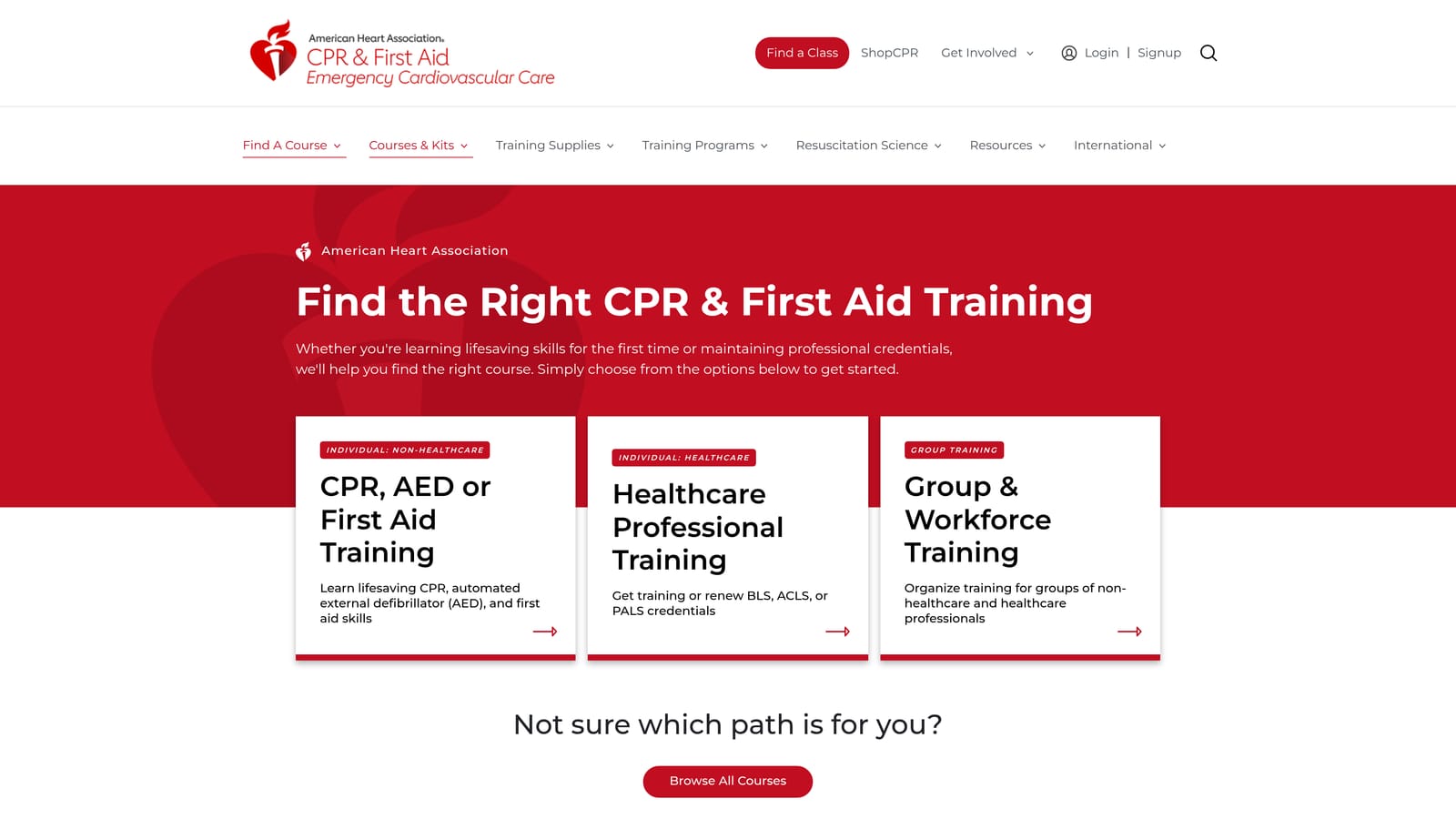
The American Heart Association writes the ACLS guidelines and curriculum, and delivers courses through authorized Training Centers rather than directly. For many hospitals, an AHA card is the default requirement, which makes this network the reference point for every other option here.
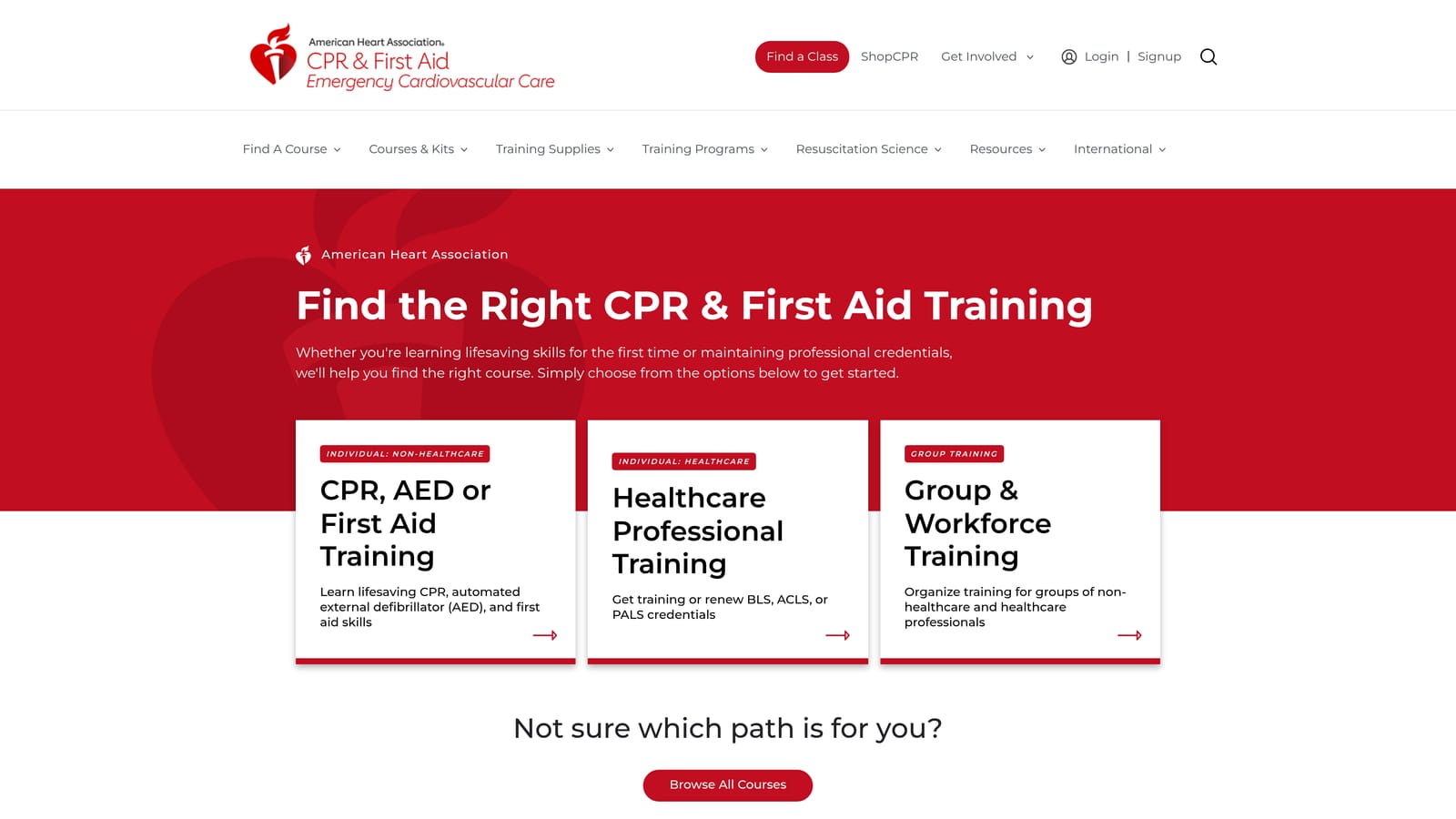
Its distinctive strength is that it is the source: the curriculum, the provider manual, and the card that credentialing offices recognize without questions. The Find a Course locator lets you search for sessions near you.
- Instructor-led ACLS classroom courses, with full skills practice and testing in one session.
- HeartCode blended learning, which moves the cognitive portion online so the in-person skills session is shorter.
- A Find a Course locator, which helps you find authorized sites and avoid look-alike vendors.
- A widely accepted AHA card, delivered as an eCard you can show an employer quickly.
Integration is limited to the AHA eCard system and the Training Center networks. Setup effort is low for an individual, but you do the vetting: you choose a site, register with it, and complete the skills session it schedules.
The limitation is variability. Price, class size, scheduling, and instructor quality depend on the authorized site you choose, so two AHA courses can feel very different. The AHA does not set one price; as of 2026, rates vary by Training Center, and the HeartCode online portion and the skills session may be billed separately.
Best for: Clinicians whose employer explicitly requires an AHA card.
3. American Red Cross
The American Red Cross is one of the best-known national training organizations, with a large local network and blended and in-person formats. Its strength is recognition and reach, particularly for CPR and BLS-level healthcare provider training.
Before you shortlist it for ACLS, verify current offerings directly. Red Cross catalogs change, and its advanced life support availability has not always matched what the AHA offers. Do not assume an ACLS-equivalent course exists in your area.
- A nationwide course network, so finding a session is rarely a problem in larger markets.
- Blended and in-person formats, letting you do coursework online and finish skills with an instructor.
- Healthcare provider CPR and BLS courses, useful if you also need foundational cards.
- Digital certificates, available to share with employers right after completion.
Learning runs on the Red Cross platform, and setup is straightforward for individuals. An employer would need to approve it, since the card is not accepted where AHA ACLS is specifically required, which is the main limitation. Many hospital credentialing offices write "AHA" into their policy.
Pricing is listed on the Red Cross site and typically varies by course and format. Check current rates as of 2026.
Best for: Learners whose employer accepts Red Cross credentials.
4. ProTrainings
ProTrainings is an online-focused provider that pairs web-based coursework with skills verification, so you are not left with a purely online card. It leans toward self-directed learners who want to study on their own time and then complete a hands-on check.
Its distinctive piece is the online-first blended model. Compared with a classroom-only course, you control the pace of the learning, and the skills check is arranged separately. That can reduce time in a classroom, though you should confirm how the skills verification is carried out in your area.
- Online coursework you can complete in short sessions around work.
- Blended skills verification, which addresses the in-person requirement many employers have.
- Healthcare and workplace courses, so one account can cover both clinical and general needs.
- Digital cards, delivered without waiting for mailed copies.
It runs on its own online learning platform, and the learner manages setup, including arranging the skills check. That coordination is the extra effort compared with showing up to a single scheduled class.
The key limitation is that ProTrainings cards are not AHA-issued, so acceptance must be confirmed with your employer or board before you enroll. Pricing is on its website and typically depends on the course and verification option, so check current rates as of 2026.
Best for: Self-directed learners whose employer accepts non-AHA cards.
5. National CPR Foundation
The National CPR Foundation is an online certification provider known for fast, low-cost courses. It is the option on this list with the least friction: study at your own pace, test, and receive a digital card quickly.
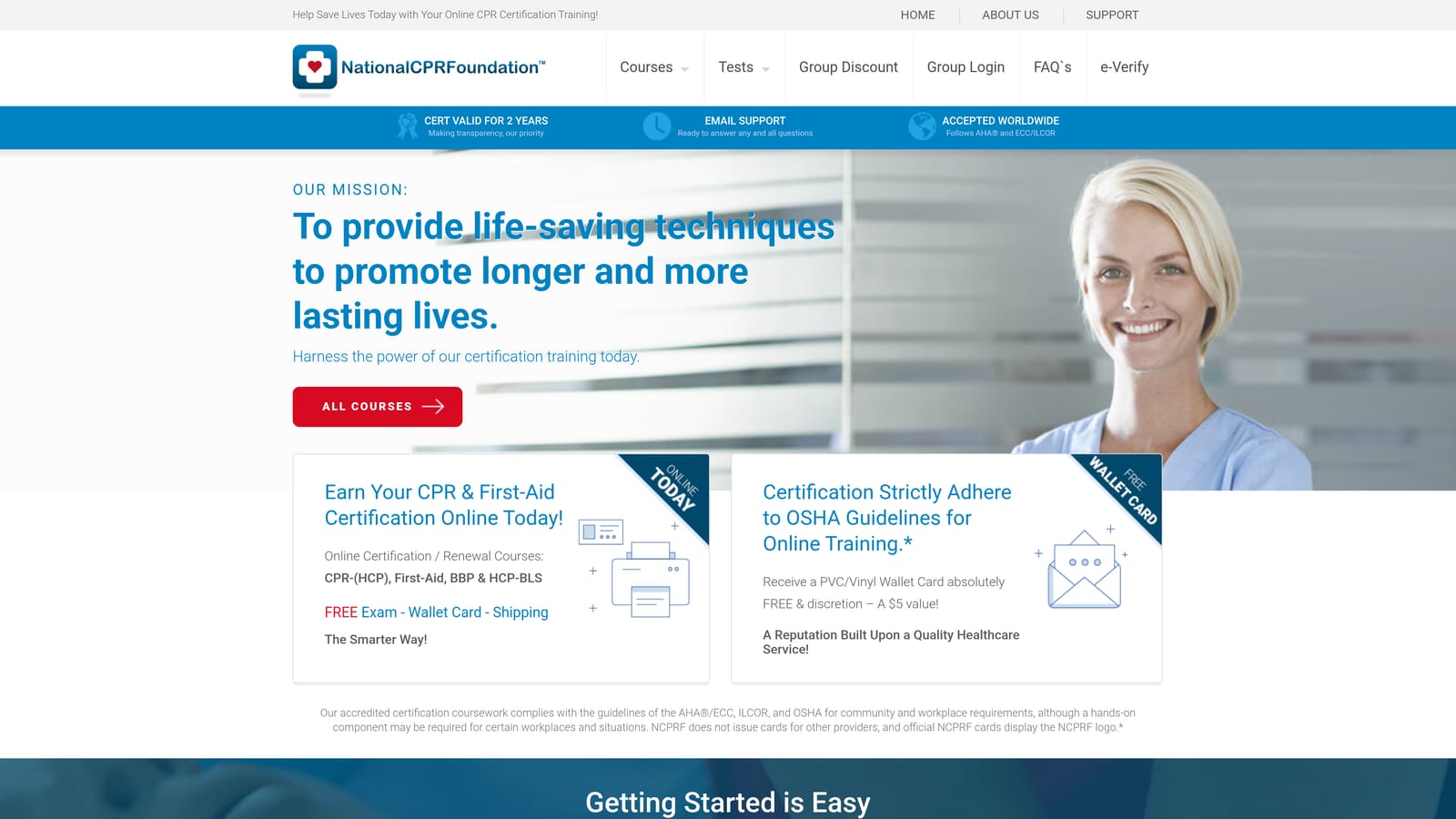
That convenience is also the central risk. Online-only courses lack the in-person skills testing that many employers, hospitals, and boards require for ACLS, and that is the misconception worth correcting: an online-only card is not equivalent to one that includes a hands-on session.
- Online courses you can start immediately, with no class to schedule.
- Quick digital card delivery, helpful when you need proof fast.
- Low-cost options, relevant if you are paying out of pocket.
- Self-paced study, so you can fit it around shifts.
There are no integrations to manage and setup is minimal, with the learner handling everything. It does not suit anyone whose employer, state board, or residency program requires AHA certification or a documented in-person skills evaluation. Confirm in writing before buying.
Pricing is listed on its website and is typically lower than instructor-led classes. Check current rates as of 2026.
Best for: Budget-conscious learners in roles with no hands-on skills requirement.
6. American Safety and Health Institute (ASHI)
The American Safety and Health Institute is a training brand under HSI that delivers CPR and first aid courses through independent training sites. Its orientation is workplace compliance, and it fits employers who want local instructors and flexible curriculum rather than a hospital credentialing pathway.
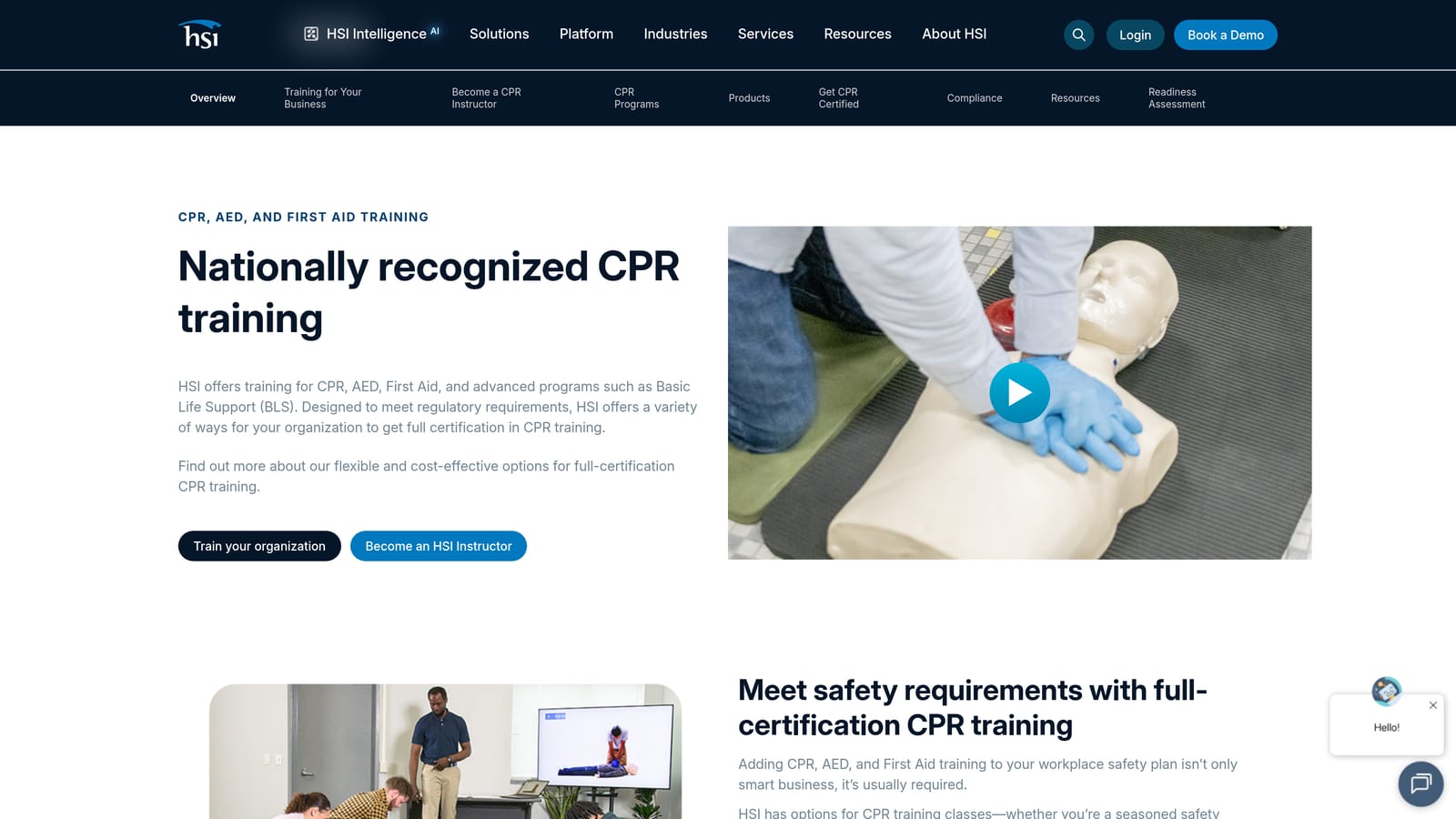
The distinctive element is the independent site model. Each site has some latitude in scheduling and format, which can help organizations that need training at odd hours or on their own premises.
- CPR and first aid courses covering the core needs of most workplaces.
- Instructor-led and blended formats, so you can balance online study and hands-on practice.
- An independent training site network, giving you local options.
- A workplace compliance focus, which helps HR and safety managers document training.
Learning runs through the HSI platform, and a safety coordinator would typically arrange classes. Verify whether a specific ACLS-level course is available in your area, because ASHI's catalog centers on CPR and first aid. It is also less recognized than AHA in hospital credentialing, so it rarely suits clinicians whose employers specify an AHA card.
Pricing is quote-based, and it depends on the site, course, and group size.
Best for: Organizations seeking workplace-oriented training from local instructors.
7. National Safety Council (NSC)
The National Safety Council is a nonprofit offering first aid, CPR, and workplace safety training. Its value is breadth: a single relationship can cover resuscitation basics alongside broader occupational safety topics.
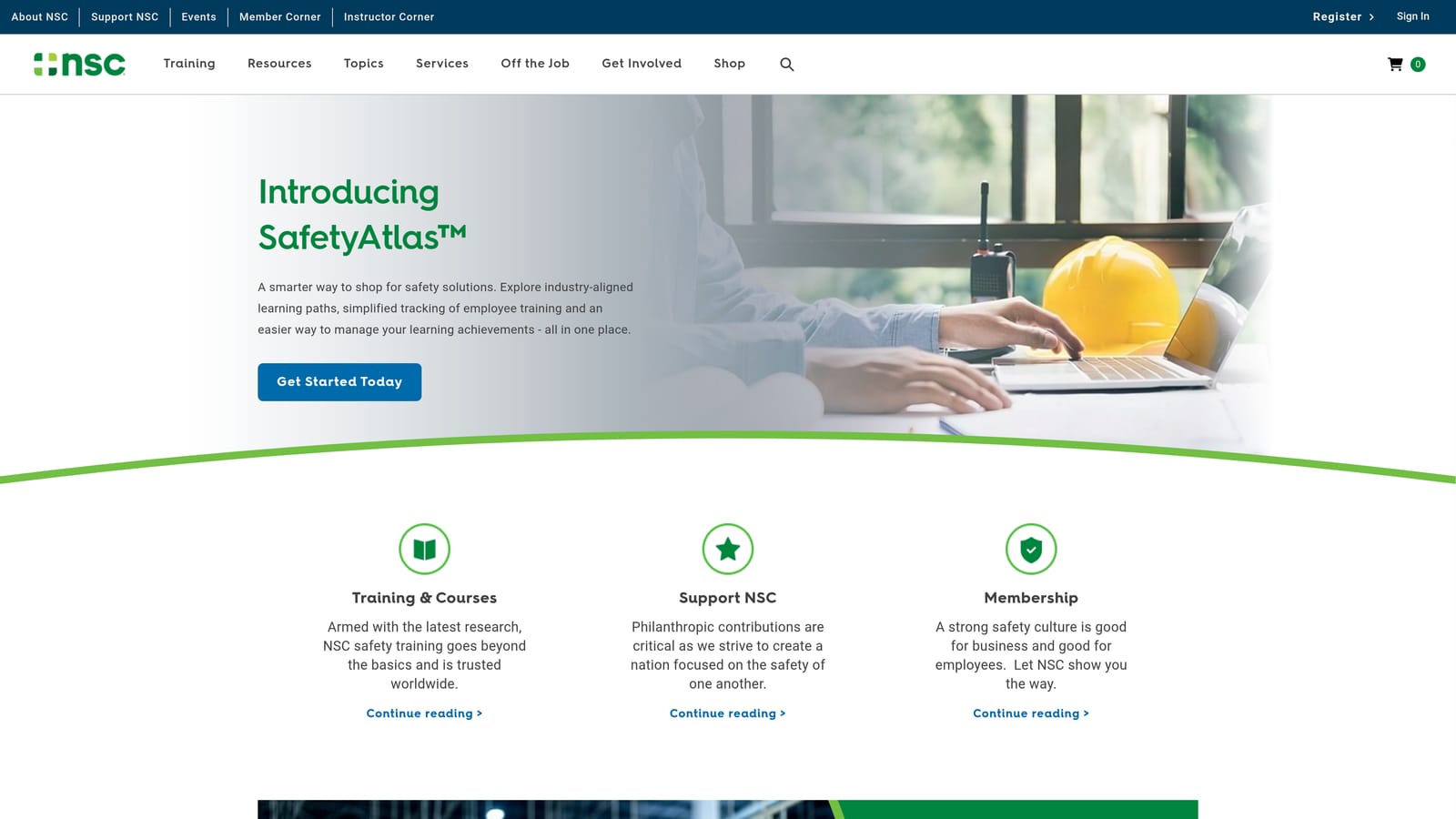
This is a different category from the clinical providers above. NSC is oriented toward workplace safety, not clinical advanced life support, so it is not a substitute for an ACLS card. Include it when you are an employer training a general workforce, not when you are a nurse facing a credentialing deadline.
- First aid and CPR courses suited to non-clinical staff.
- Workplace safety curriculum, so safety programs can be built under one provider.
- An instructor network, which supports in-person delivery.
- Employer programs, designed for organizations rather than individual clinicians.
There are no integrations to speak of, and setup typically sits with an HR, safety, or compliance lead who chooses courses for a team. Confirm exactly which life support courses are currently offered before assuming any advanced content is available.
Pricing is on the NSC website and generally depends on the course and the number of participants. Check current figures as of 2026.
Best for: Employers bundling safety training across a workforce.
8. Local Hospital and EMS Training Centers
Local hospital, college, and EMS agency training centers operate AHA Training Sites that teach ACLS, and the AHA course search is the easiest way to find them. They are often the most clinically grounded option available.
What they do best is realism. Instructors are working clinicians, and simulation equipment such as manikins with rhythm generators and defibrillators is often better than what a small private provider keeps on hand. Megacode practice tends to feel closer to the code you run on the unit.
- Clinical instructors who can tie algorithms to real practice.
- Realistic simulation equipment for more lifelike team scenarios.
- Employee discounts, which can lower or remove the cost for staff.
- Schedules aligned to staff needs, such as shift-friendly sessions.
Cards are issued as AHA eCards, and setup usually runs through an education department or a unit educator. The limitation is access: seats may be limited to employees or students, and dates can be infrequent, so a missed class can mean a long wait. That is a real problem if your card is about to lapse.
Pricing varies by institution, and some are free to internal staff. Contact the site for current rates as of 2026.
Best for: Hospital staff and students who can access in-house training.
9. NAEMT
NAEMT, the National Association of Emergency Medical Technicians, is a national association for EMS practitioners that offers advanced education such as AMLS (Advanced Medical Life Support) and PHTLS (Prehospital Trauma Life Support). It is the specialist pick here, aimed at prehospital care.
Its distinguishing feature is scenario content built around the field: patient assessment in uncontrolled environments, transport decisions, and trauma and medical emergencies. That is useful for paramedics and EMTs whose work does not look like an inpatient unit.
- AMLS and PHTLS courses that deepen medical and trauma assessment skills.
- A prehospital focus, so content reflects EMS realities rather than hospital workflows.
- An instructor network that delivers courses through local affiliated sites.
- EMS-oriented scenarios that build decision-making under field conditions.
There are no integrations to configure, and an EMS agency training officer often coordinates enrollment. The main limitation is that NAEMT courses complement rather than replace ACLS for most hospital credentialing. You will likely still need a separate ACLS card, often from AHA.
Pricing is on the NAEMT site and varies by course and the hosting site. Check current rates as of 2026.
Best for: Paramedics and EMTs adding prehospital advanced training.
Matching an ACLS Provider to Your Situation
Start with acceptance, because it narrows the field faster than price. Ask your employer, program, or licensing board which cards they accept and whether a hands-on skills session is required. If they say AHA, confirm the provider is an authorized AHA Training Center or instructor before paying.
- Hospital requires an AHA card: the AHA Course Network, a local hospital training center, or Best Emergency Services Training.
- Renewal on a tight schedule: Best Emergency Services Training, where fast scheduling and one-on-one home instruction can fit around shifts.
- Group training for a practice or department: Best Emergency Services Training for onsite AHA classes; ASHI or NSC where an AHA card is not required.
- EMS clinicians: NAEMT for AMLS and PHTLS, plus an AHA ACLS card for credentialing.
- Budget online options: ProTrainings or National CPR Foundation, only after your employer confirms they accept non-AHA or online cards.
Don't let certification deadlines stress you out. Get your AHA, ECSI or HSI-certified CPR training completed quickly with flexible scheduling that works around your life. Schedule your personalized training session today and join the thousands of individuals and businesses who trust B.E.S.T. for fast, convenient certification with expert instructors.