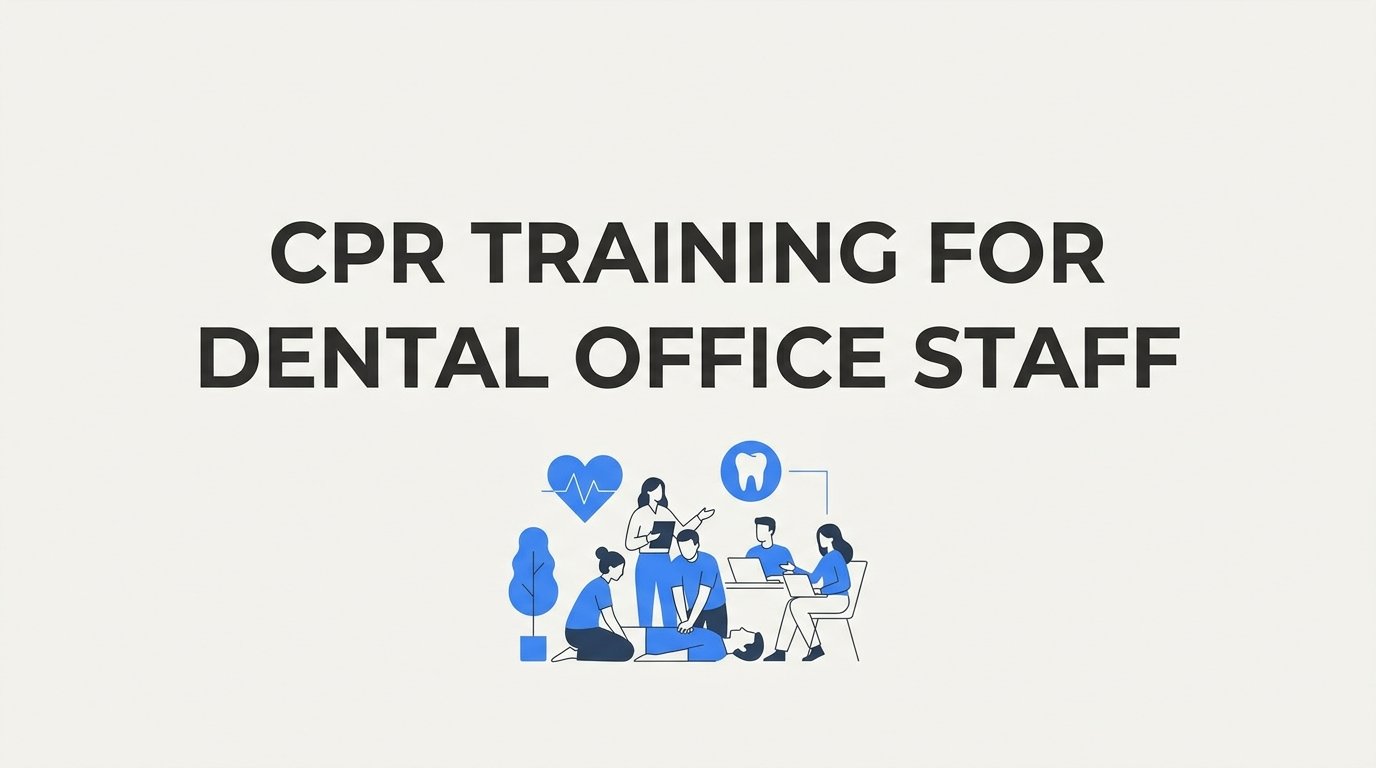
A patient goes pale and unresponsive while reclined for a routine cleaning. A local anesthetic triggers an allergic reaction mid-procedure. A sedation case takes an unexpected turn on the airway. Dental offices carry a distinct set of medical emergencies that a standard corporate CPR refresher was never designed to address, and the staff who freeze in those first sixty seconds can turn a manageable event into a preventable tragedy. Building a CPR training program that actually reflects your practice, its equipment, its layout, and its patient population takes more planning than scheduling a generic class once every two years. The strategies below give dental office managers and dentists a practical framework for matching certification level to real risk, rehearsing dental-specific scenarios, and keeping the whole team ready between renewal cycles.
1. Match Certification Level to Actual Dental Emergency Risk
Not every role in a dental office carries the same responsibility during a medical emergency, so not every role needs the same certification. The American Heart Association draws a clear line between BLS for Healthcare Providers, designed for clinical staff who may need to perform high-quality CPR as part of a team response, and Heartsaver CPR, a layperson course built for people with less frequent patient contact. Applying the wrong tier in either direction either leaves clinical staff underprepared or wastes training hours on non-clinical employees.
Consider a practice with four hygienists, two assistants, and a front desk coordinator. The clinical staff, who work directly in patients' mouths and are present for sedation and anesthetic administration, complete BLS for Healthcare Providers. The front desk coordinator, who rarely has hands-on patient contact but should still be able to respond in a pinch, completes a Heartsaver CPR course. The result is a team that's appropriately trained without over-certifying every role.
- Review each role's level of direct patient contact, including exposure to sedation, injections, and reclined-chair procedures.
- Check your state dental board's stated minimum certification requirement for license renewal, since this varies by state and by license type.
- Enroll clinical staff in BLS for Healthcare Providers and non-clinical staff in a layperson CPR course.
- Document the certification tier assigned to each role so future hires are trained consistently.
The common mistake here is assuming a basic Heartsaver card satisfies a state board's requirement for hygienists or assistants who provide direct patient care. Boards typically expect healthcare-provider-level training for anyone performing clinical procedures, and an audit that turns up the wrong certification tier can jeopardize a license. Track the percentage of clinical staff holding a current BLS for Healthcare Providers card, verified directly against your state board's published minimum, not just against what the office has always done.
2. Schedule Onsite Group Sessions Around Practice Closures
Training lands differently when the whole team learns together on the same day, using the same instructor, working through the same scenarios. Onsite group sessions also solve the scheduling problem that derails so many good intentions: finding a time when four, six, or ten staff members can all step away from clinical duties at once.
Suppose a practice closes at noon on the first Wednesday of each quarter specifically for staff development. That closure window gives Best Emergency Services Training enough time to run a full onsite BLS session for the entire team without sacrificing a complete clinical day or asking staff to use personal time.
- Pick a recurring closure window that the whole team can count on, such as a quarterly half-day.
- Confirm the minimum group size and room requirements with your training provider before booking.
- Book the session at least a month in advance to avoid conflicts with patient scheduling.
- Communicate the closure to patients early so appointment volume doesn't creep into the training window.
The mistake to avoid is scheduling training during a partial closure that still has patients booked. Half-closed schedules create pressure to rush the course or pull staff out mid-session to handle a patient, which undermines the training and frustrates the instructor and the team alike. Measure success by the number of staff who complete certification in a single scheduled session versus the number who need a separate makeup session, since a high makeup rate usually signals a closure window that wasn't actually protected.
3. Build Scenarios Around Dental-Specific Emergencies
Standard AHA courses teach the compressions, breaths, and AED use that form the foundation of any emergency response, but they don't cover the specific triggers common in a dental chair. Vasovagal syncope, a fainting episode brought on by stress, pain, or the sight of instruments, is one of the most frequent medical events in a dental office, and it looks nothing like a straightforward cardiac arrest. Staff need to recognize it, and they need to know what to do differently when a patient is reclined rather than lying flat on the floor.
Picture a staff drill where an assistant notices a patient going pale and unresponsive mid-procedure. Instead of practicing only on a mannequin already positioned on the ground, the assistant practices the full sequence: recognizing the signs, calling for help, repositioning the dental chair to a supine position, and then beginning compressions if needed. That sequence, chair to floor to compressions, is exactly what a generic course skips.
- Ask your training provider to add a dental-specific scenario segment after the standard AHA course content.
- Cover syncope response, local anesthetic allergic reactions, and sedation-related airway complications.
- Walk through the contents of your specific emergency kit so staff know what's actually available, not a generic kit list.
- Practice the notification protocol for alerting the treating dentist during a mock event.
The common mistake is treating the AHA course itself as the complete emergency plan, when it's really the foundation for a plan the office still has to build. Measure the time from recognizing a mock emergency to the correct first response step during a drill, and look for that interval to shrink with each rehearsal.
4. Train on the AED and Airway Tools Actually Kept in the Office
An AED that staff have never touched is a liability disguised as a safety measure. Every AED model has slightly different pad placement, voice prompts, and power controls, and the seconds lost fumbling with an unfamiliar device during a real event matter. The same applies to a bag-valve-mask or oxygen tank: knowing how one works in theory is not the same as knowing how the specific unit mounted on your office wall works.
A useful exercise: have staff locate the office's wall-mounted AED from wherever they're standing when the drill starts, then retrieve it and demonstrate pad placement on a mannequin. Add a second step where staff practice moving a patient from a reclined dental chair to a flat surface, since that repositioning is different from moving someone off an exam table and is often the part teams are least prepared for.
- Bring the practice's own AED, oxygen tank, and bag-valve-mask to the training session rather than relying solely on instructor-provided equipment.
- Have every staff member locate and operate the actual equipment at least once during the session.
- Practice the chair-to-floor repositioning specifically, since it's unique to dental settings.
- Note where equipment is stored relative to each treatment room and adjust placement if retrieval takes too long.
The pitfall is training exclusively on the instructor's classroom devices and never touching the equipment that will actually be used in an emergency. Track the average time for staff to locate and prepare the AED during a timed drill, and treat any time over roughly 60 to 90 seconds as a signal to either retrain or relocate the device.
5. Assign and Rehearse Emergency Response Roles
Certification tells staff what to do medically. It doesn't tell them who does what when three people converge on the same patient at once. Without assigned roles, offices tend to see either duplicated effort, three people all reaching for the phone, or gaps, nobody grabbing the emergency kit because everyone assumed someone else had it.
One practical approach: post a laminated card in the staff break room listing four roles: who starts compressions, who calls 911, who retrieves the emergency kit, and who documents the timeline of events. Rotate the assignments quarterly during rehearsal so every staff member, not just the most senior hygienist, is comfortable stepping into each role.
- List every role needed during a medical emergency response, including a documentation role often overlooked in planning.
- Assign a primary and a backup staff member to each role, accounting for vacation and turnover.
- Post the assignments somewhere visible to the whole team, not buried in a policy binder.
- Rehearse the assignments during regular staff meetings, not just during the certification renewal cycle.
The common mistake is writing the plan once and filing it away without rehearsal. A role assignment that exists only on paper tends to fall apart under real pressure because staff hesitate, unsure whether they're actually supposed to act. Spot-check readiness by asking individual staff members to state their assigned role and their backup assignment, and track the percentage who answer correctly without checking the posted card.
6. Track Certification Renewal Dates Across the Whole Team
AHA BLS certification is typically valid for two years, and that consistency makes it easy to plan around, provided someone is actually watching the calendar. The problem most offices run into isn't a lack of awareness that certifications expire. It's that tracking gets distributed across individual staff members, and individual memory is an unreliable system for something tied to license compliance.
An office manager who logs every staff certification date in the practice management system, then sets automated reminders at 90 and 30 days before each expiration, avoids the last-minute scramble entirely. That lead time is enough to book a renewal session, including an onsite group session if enough staff are due around the same time, rather than sending a single hygienist out to a same-week class at a premium price.
- Log every staff member's certification type and expiration date in one shared system.
- Set automated reminders at 90 days and again at 30 days before expiration.
- Group upcoming renewals together where possible to justify scheduling an onsite session instead of individual offsite classes.
- Review the tracking log quarterly as part of a standing staff meeting agenda item.
The common mistake is letting each staff member manage their own renewal individually. That approach produces uneven certification status across the team and forces last-minute, less convenient scheduling when someone realizes their card lapsed. The metric that matters here is simple: the number of staff with a lapsed certification at any point during the year, with zero as the standing target.
7. Choose the Right Training Format for Your Office Size
The right training format depends less on preference and more on the practical shape of your practice: how many staff need certification, how flexible their schedules are, and how much physical space you have to work with. Best Emergency Services Training offers onsite group training, offsite classroom locations, and one-on-one home instruction specifically because no single format fits every practice.
Consider two contrasting cases. A solo practitioner with one hygienist has almost no scheduling flexibility and no need for a group setting, so one-on-one home instruction fits best, letting the session happen around the practice's tight patient calendar. A five-location dental group, by contrast, needs consistency across sites and enough volume to justify onsite sessions at each location, keeping skills and terminology uniform across the whole organization.
- Count total staff needing certification and note how many can realistically train together at once.
- Assess available space for an onsite session, including room for hands-on equipment practice.
- Evaluate schedule flexibility, since tightly booked solo practices often benefit more from one-on-one instruction.
- Choose onsite group training for larger teams, offsite sessions for staff needing individual scheduling flexibility, or one-on-one instruction for small offices.
The mistake many practices make is defaulting to the same format every renewal cycle without reassessing whether staff size or scheduling needs have actually changed. A practice that added two hygienists since its last renewal cycle may now have enough volume to justify an onsite session it previously skipped. Compare staff satisfaction and completion rate for the chosen format against the prior renewal cycle to see whether the format still fits.
Building Readiness One Renewal Cycle at a Time
If you're starting from scratch, begin with matching certification levels to each role and scheduling an onsite group session. Those two steps establish the baseline skill set that everything else in this list builds on: you can't rehearse dental-specific scenarios or assign emergency roles effectively until the right people hold the right certification and the whole team has trained together at least once. From there, layering in equipment-specific practice, role assignments, and a renewal tracking system becomes a matter of refinement rather than a rebuild.
Don't let certification deadlines stress you out. Get your AHA, ECSI or HSI-certified CPR training completed quickly with flexible scheduling that works around your life. Schedule your personalized training session today and join the thousands of individuals and businesses who trust Best Emergency Services Training for fast, convenient certification with expert instructors.