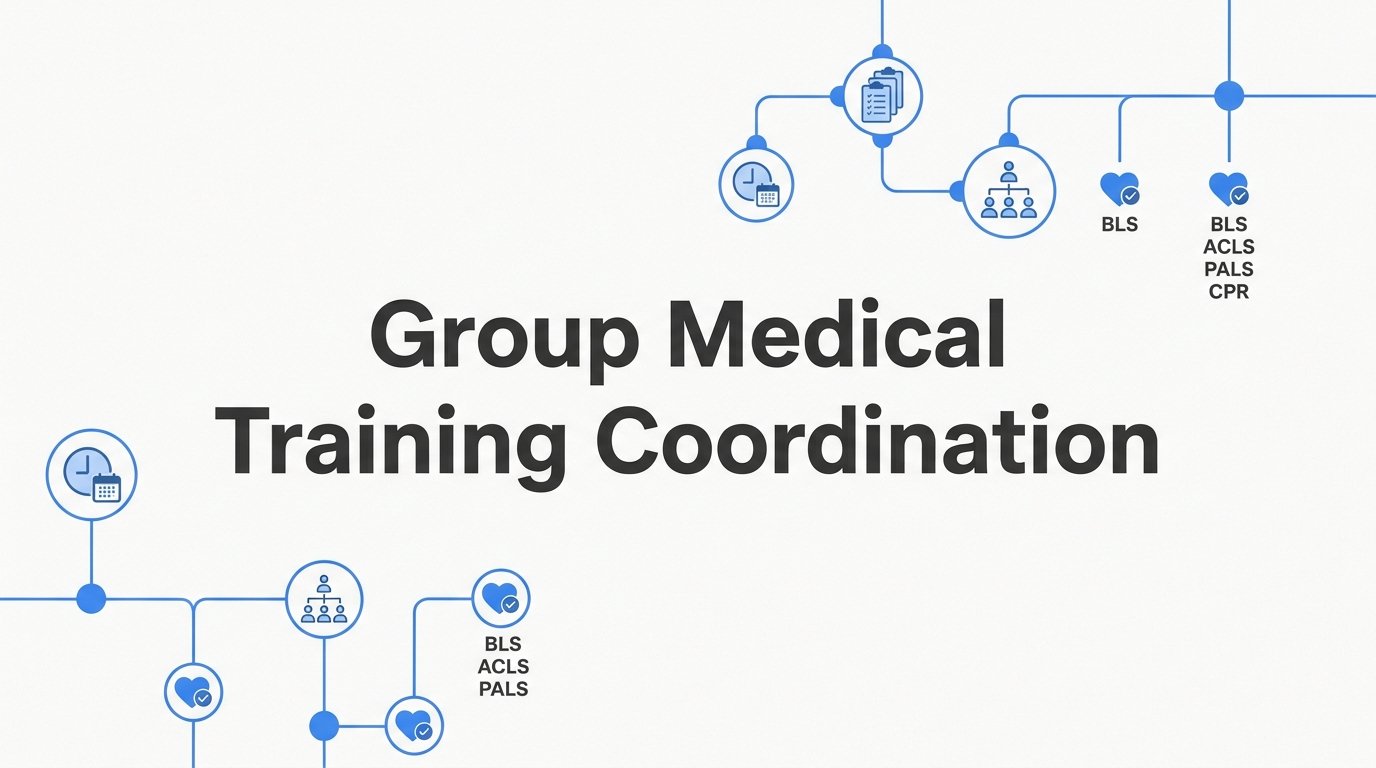
Getting a whole team certified in AHA courses is less a training problem than a coordination problem. This guide walks you through group medical training coordination from first audit to renewal system, so your staff hold valid BLS, ACLS, PALS, or CPR cards on schedule and units stay covered while classes run. Before you start, gather a current staff roster, each person's certification expiration date (if they have one), and any regulatory or employer requirements that apply to your roles. A few terms you will see throughout: BLS is Basic Life Support, ACLS is Advanced Cardiovascular Life Support, PALS is Pediatric Advanced Life Support, and an eCard is the electronic provider card the AHA issues after a successful course.
Step 1: Audit Who Needs Which Certification
Start with one spreadsheet that holds everyone in scope. Use these columns: name, role, current card type, issue date, and expiration date. AHA provider cards are generally valid for two years (confirm current AHA policy as of 2026), so sort the sheet by expiration month. Clusters will appear immediately, and those clusters become your class cohorts later.
Next, match each role to a course instead of assuming everyone needs the same one. A typical starting point looks like this:
- BLS: most clinical staff, including nurses, medical assistants, dental teams, and techs.
- ACLS: clinicians who manage adult cardiac emergencies, such as critical care, emergency, and code team members.
- PALS: staff who care for infants and children in emergency or acute settings.
- CPR and First Aid: non-healthcare staff such as front desk, administrative, school, or facilities employees.
Treat that list as a default, not a rule. Confirm each requirement against your employer policy, state licensing board, or accreditor. A requirement you assumed can be wrong in either direction: you may be over-training some roles and under-training others.
Finally, flag anyone with a lapsed card. Renewal courses are usually shorter, but they generally require a current, unexpired card, so a person who let theirs lapse may need the full provider course. Eligibility rules change, so ask your training provider to confirm current AHA renewal criteria before you decide how to group these people. Putting lapsed staff in a separate cohort keeps your renewal classes short and your full-course classes properly sized.
Step 2: Choose the Training Format That Fits Your Team
Your audit tells you how many people need training and where they are. Format follows from that. Best Emergency Services Training offers several delivery options, and each suits a different situation:
- Onsite group training: an instructor comes to your facility. Best for larger teams or when pulling people off the floor for travel is costly.
- Offsite classes: staff attend at one of several training locations. Best for small numbers or employees spread across sites.
- One-on-one or home instruction: best for individuals with unique scheduling needs, mobility considerations, or a tight deadline.
For example, imagine a clinic with 25 staff. Onsite delivery in two cohorts likely beats sending everyone elsewhere, because nobody loses travel time and the clinic can stagger coverage. Now imagine three remote employees from the same organization with expirations in different months. Sending them to an offsite session, or arranging individual instruction, is usually simpler than convening a private class for three people.
Decide whether blended learning fits
Blended learning splits a course into an online cognitive portion and an in-person hands-on skills session. It can shorten time in the classroom, which helps with coverage. The part to protect is the skills session: the AHA requires hands-on skills practice and testing with an instructor for a valid provider card. Fully online-only certificates are a common and costly mistake, because many employers and boards will not accept them. If a course promises a card with no in-person component, treat that as a warning sign and move to Step 3 before you pay for anything.
Step 3: Verify the Provider and the Card You Will Receive
Before booking, confirm the provider is an authorized AHA Training Center or teaches under one. Ask for that relationship in plain terms, and ask that your staff receive an AHA-issued eCard rather than a generic certificate of completion. The card is the deliverable, so verify it first.
Then check acceptance on your side. Contact your licensing board, HR department, or accreditor and ask whether they accept the specific card you plan to buy. Some employers reject non-AHA credentials, and some reject anything without verified hands-on skills. A five-minute email now prevents a whole cohort from needing to retake a class.
Questions to ask before you book
- What is the instructor-to-student ratio?
- How many manikins will each group share? Fewer people per manikin means more practice time for everyone.
- Which equipment does the provider bring (manikins, AED trainers, bag-valve masks, monitors for ACLS), and what must you supply?
- How soon after class are eCards issued, and how will staff receive the claim instructions?
- What happens if someone does not pass on the first attempt?
Write the answers down. If you are comparing two providers, these five answers will separate them faster than price will. Smaller ratios, adequate manikins, and quick eCard turnaround all protect your schedule and your staff's time.
Step 4: Build a Schedule That Protects Patient Coverage
Never train an entire unit at once. Use the expiration clusters from Step 1 and split large teams into cohorts so each department keeps enough licensed staff on duty. Early morning, evening, and weekend sessions can help when daytime coverage is tight, but check that your instructors and room are available at those times and that you are not creating overtime problems.
Estimate session length by course. BLS is typically a half-day or less, while ACLS and PALS run longer, and renewal formats are often shorter than first-time courses. Durations and formats change, so verify current lengths with Best Emergency Services Training as of 2026 rather than relying on last cycle's numbers. Add buffer time for check-in, ID verification, and late arrivals, because a class that starts 20 minutes behind pushes everything else.
Set your target date well ahead of the earliest expiration in the group. A margin of several weeks gives you room to handle a cancelled session, an illness, or a retest without anyone dropping out of compliance. Then hold a backup session. Absences are close to certain with a large group, and new hires will arrive between cycles. A backup date you hold in advance costs little. Scrambling for an emergency class the week before a deadline costs much more.
Step 5: Handle Logistics, Space, and Accommodations
Reserve a room with enough open floor for manikin practice, comfortable seating for the lecture and video portions, and a screen or wall for projection. A conference room that seats 12 for a meeting often cannot support 12 people kneeling at manikins, so think about floor space, not chair count. Confirm with the provider what they bring and what you must supply, such as an extension cord, a projector, or a table.
Ask about accommodations early. Participants with physical limitations, such as a back, knee, or wrist condition, may need modified positioning for compression practice, seating options, or extra time, and a good provider can usually adapt so everyone can complete the skills test. Best Emergency Services Training accommodates physical limitations, and raising these needs before class day is far easier than solving them in the room. If an individual needs more than a group setting can offer, one-on-one instruction is the fallback.
Finally, send participants a reminder one to two weeks ahead. Include:
- The date, start time, and exact location, including parking or entrance details.
- Required prerequisites, such as a completed online module for blended courses or ACLS and PALS pre-course work.
- What to bring: an existing card if renewing, a photo ID, and comfortable clothing suited to kneeling on the floor.
- Who to contact if they cannot attend.
- Create calendar reminders at 90 and 60 days before each group's expiration date. Ninety days is when you book the class, and sixty is when you confirm attendance and chase stragglers.
- Keep every certification record in one central place, not scattered across email threads and individual files. Review it quarterly so changes in staffing or roles are caught early.
- Book the next group session before the current one ends. Your provider can usually hold dates, and doing it while the instructor is in the room is far easier than starting from scratch in 22 months.
- Consider a recurring arrangement for new hires, such as a standing monthly or quarterly class, so nobody works long without a valid card.
Step 6: Run the Session and Track Completion
Assign one internal point person for each session. This person takes attendance, answers logistics questions, keeps breaks on time, and serves as the instructor's contact. It should not be a participant who needs full attention on the material, so choose a coordinator or supervisor who is not testing that day if you can.
Make sure participants know that skills testing and any written exam are pass/fail. Remediation is typically available for people who do not pass the first time, but the details vary by provider and course, so ask the instructor how it works. Follow up the same day with anyone who needs it, and book their retest before they leave rather than leaving it open-ended.
After class, the paperwork matters as much as the instruction. Within a few days, collect confirmation that each participant has claimed their eCard. Staff sometimes ignore the claim email, and a card that is never claimed is a card you cannot verify. Then record the new issue and expiration dates in your spreadsheet, replace the old values, and note the course type. A session is not complete until those dates are logged, so treat the data entry as the final task of the day.
Step 7: Set Up a Renewal System So Nothing Lapses
Cards do not need attention for two years, which is exactly why they get forgotten. Build the system now while the dates are fresh.
Also revisit the role-to-course matches from Step 1 whenever policies or job duties change. A person who moves from a front desk role to clinical work needs a different card than the one on file.
Keeping Your Team Certified After the Last eCard Arrives
Once your roster, format, provider, and renewal reminders are in place, confirm every eCard is on file and that each expiration date is entered in your tracker. That check turns a single successful class into a system you can hand to the next coordinator.
Don't let certification deadlines stress you out. Get your AHA, ECSI, or HSI-certified CPR training completed quickly with flexible scheduling that works around your life. Schedule your personalized training session today and join the thousands of individuals and businesses who trust B.E.S.T. for fast, convenient certification with expert instructors. Best Emergency Services Training can bring group sessions to your facility, host your staff at an offsite location, or arrange one-on-one instruction for anyone who needs it.