Keeping your CPR certification current is less about memorizing a two-year rule and more about knowing when to act, what course to take, and how to avoid the gap that trips up so many healthcare professionals and workplace cardholders. This guide walks through the exact steps to renew on time, choose the right course type, and set up a system so you never have to scramble again. By the end, you will know exactly how to keep your CPR certification current, whether you hold BLS, Heartsaver, ACLS, or PALS. All you need is your current card's expiration date and a few minutes to map out your renewal window.
Step 1: Check Your Certification's Expiration Date and Type
Start by pulling out your current card and locating the expiration date. American Heart Association cards are issued for two years from the date you completed the course, not from the date you received the physical or digital card, so check the completion date printed on the front. This two-year window applies across BLS, ACLS, and PALS courses, though as of 2026 you should always confirm current policy language with your training provider since expiration handling can vary slightly by organization.
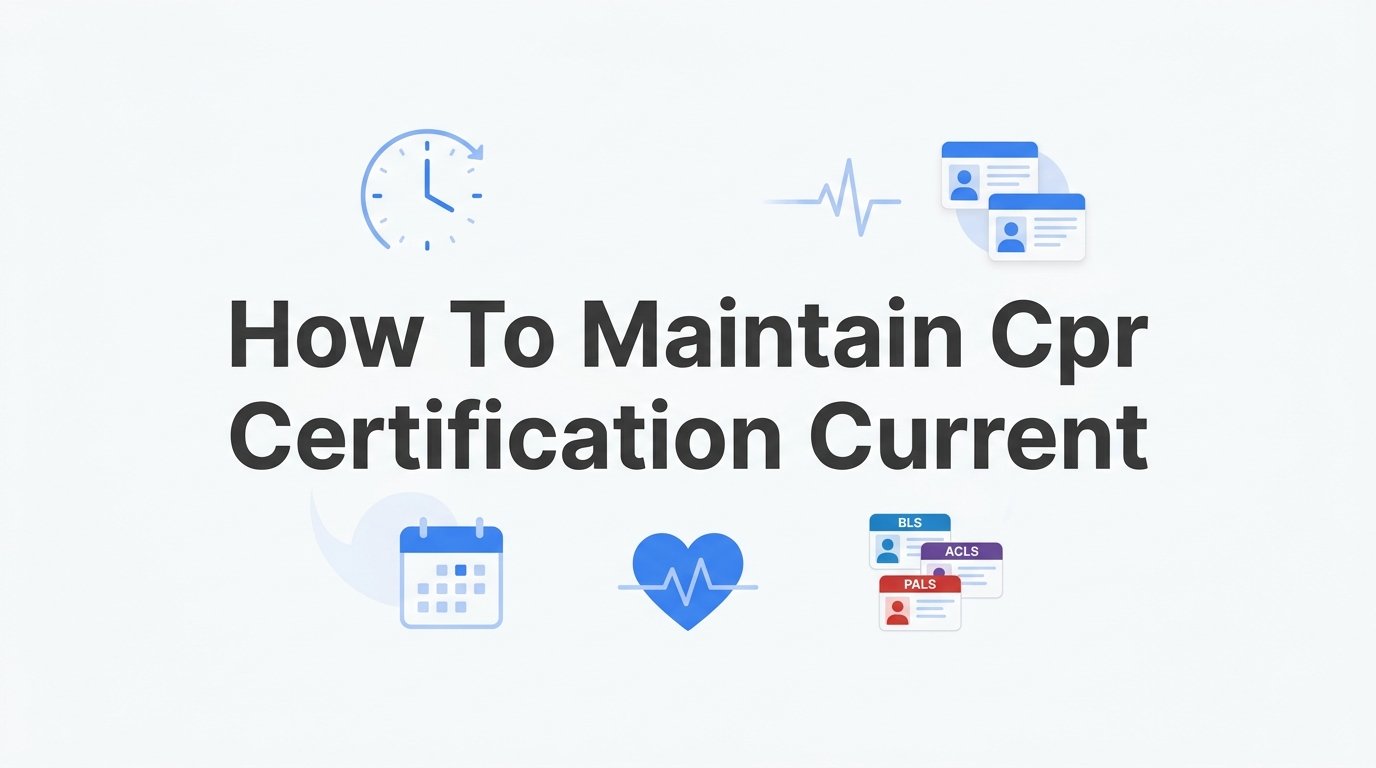
Next, confirm exactly which certification you hold. This matters more than most people realize, because renewal requirements, course length, and content differ depending on the card type:
- BLS (Basic Life Support): designed for healthcare providers and covers adult, child, and infant CPR, AED use, and team dynamics.
- Heartsaver CPR: intended for non-healthcare workers, teachers, and general workplace requirements, with a simpler skills set.
- ACLS (Advanced Cardiovascular Life Support): built for providers who manage cardiac emergencies, including medication protocols and rhythm recognition.
- PALS (Pediatric Advanced Life Support): focused on pediatric emergency response for providers who treat infants and children.
A common mistake here is assuming your CPR card follows the same renewal cycle as other workplace-required training, like OSHA safety courses, which often run on annual or employer-set schedules. CPR certifications from the American Heart Association follow their own two-year cycle regardless of what other compliance training your employer tracks. Mixing up these timelines is one of the most frequent reasons providers discover their card has lapsed without warning. Take a moment now to write down both the expiration date and the exact card type so you know precisely what you are renewing.
Step 2: Mark Your Calendar 60 to 90 Days Before Expiration
Once you know your expiration date, work backward and set a reminder for 60 to 90 days before that date arrives. This window gives you enough breathing room to find a class that fits your schedule, rather than settling for whatever slot happens to be open the week your card expires. Many employers and licensing boards require an active, unexpired card at all times, not just at the moment of a scheduled audit, so a lapse of even a few days can technically put you out of compliance.
Waiting until the final week before expiration is riskier than it seems. Classes fill up, especially around common renewal periods, and if your preferred instructor or location is booked, you may be forced to choose a less convenient time or travel further than you'd like. A single scheduling conflict, like a shift change or family emergency, can push you past your expiration date with no cushion left to recover.
Best Emergency Services Training builds flexibility into this exact window. Evening and weekend classes are available specifically so that healthcare professionals working long shifts, or workplace cardholders juggling full-time jobs, can find a slot that doesn't require rearranging their entire week. Onsite, offsite, and one-on-one home instruction options mean you are not limited to a single class location or time slot. Setting your reminder early and reaching out to schedule as soon as that 60 to 90 day window opens gives you first pick of available times, rather than leaving you to take whatever is left.
Step 3: Choose the Correct Renewal Course
Not every renewal situation calls for the same course. If your card has not yet expired, or has only recently lapsed, a renewal or refresher course is typically the right fit. These courses are shorter than an initial certification course because they assume you already have foundational skills and simply need to demonstrate continued competency along with any updated guidelines.
If your card has been expired for an extended period, you may need to retake the full initial course rather than a shortened refresher. This is where a lot of confusion happens: the American Heart Association itself does not publish an official universal "grace period" for lapsed cards. Instead, individual training providers set their own policies about how long after expiration a refresher course is still acceptable versus when a full course becomes required. Do not assume that an expired card can always be "refreshed" no matter how long it has been sitting inactive. Check with your provider directly to confirm which course applies to your specific timeline.
Once you know whether you need a refresher or a full course, consider which format works best for your schedule:
- Onsite classes: traditional group instruction at a training location, ideal if you prefer a structured classroom environment with peers.
- Offsite locations: multiple locations available for added convenience, useful if you want to renew closer to home or work rather than traveling to a single fixed site.
- One-on-one home instruction: personalized sessions in your own space, well suited for providers with tight schedules, mobility considerations, or a preference for individual attention rather than a group setting.
Best Emergency Services Training offers all three formats, which means the course-type decision and the scheduling decision can happen at the same time, rather than forcing you to find a provider that offers your preferred format separately.
Step 4: Complete Any Required Pre-Course Study
Before you walk into your renewal session, spend some time reviewing the current AHA guidelines or student manual for your certification level. This is not busywork. Guidelines occasionally shift between cycles, and specifics like compression depth, compression rate, and compression-to-ventilation ratio have been revised in past guideline updates. Relying on what you memorized two years ago can mean walking into your skills test with outdated technique, which slows down the class for you and your instructor.
As of 2026, always check the current AHA guidelines rather than assuming the standards from your last certification cycle still apply exactly as you remember them. Even small changes, such as adjustments to ventilation timing or AED pad placement recommendations, can affect how you perform during hands-on skills testing.
Reviewing the manual ahead of time also speeds up the actual class. Renewal courses move at a faster pace than initial certification courses because they assume a baseline of prior knowledge. If you show up having already reviewed the material, you spend less time relearning fundamentals and more time simply confirming your muscle memory during skills practice, which makes for a smoother, faster session overall.
Instructors at Best Emergency Services Training can point students toward the most current materials ahead of the scheduled session, so you are studying from the right version of the guidelines rather than an outdated manual you may have saved from years prior. If you are unsure which edition of the student manual applies to your card type, reach out before your class date and confirm rather than guessing.
Step 5: Attend the Renewal Course and Complete Hands-On Skills Testing
The renewal course itself centers on two components: hands-on skills testing and a written or online exam. For CPR renewal, expect to demonstrate compressions and rescue breaths across adult, child, and infant scenarios, along with proper AED use. Depending on your certification level, you may also be tested on team dynamics, airway management, or medication protocols if you hold ACLS or PALS.
Skills testing is where most of the actual learning happens during a renewal course, since it reveals which habits have drifted since your last certification. One of the most common corrections instructors make during skills checks involves incomplete chest recoil. Under time pressure, many providers unconsciously lean on the chest between compressions instead of allowing it to fully rise, which reduces blood flow back into the heart between compressions. This is a small technical detail, but it's one of the most frequently flagged issues during renewal testing, and it's worth focusing on if you know it's a habit you've developed.
Personalized, small-group attention makes a real difference here, particularly for professionals who have physical limitations, are recovering from an injury, or simply feel rusty after two years away from hands-on practice. Rather than being rushed through a skills station in a large class, smaller group sizes and one-on-one instruction give you room to ask questions, repeat a technique until it feels right, and get direct feedback rather than a generic pass or fail. This is especially valuable for providers who need accommodations for physical limitations, since instructors can adjust positioning or technique guidance without holding up an entire room of other students.
Once skills testing and the written or online exam are complete, you'll know immediately whether you've passed, and any areas that need a second attempt are addressed on the spot rather than requiring you to reschedule an entirely new session.
Step 6: Receive Your Updated Card and Verify Employer Requirements
After completing your renewal course, card issuance is typically fast. Many providers, including Best Emergency Services Training, offer same-day or quick digital card turnaround, which means you can update your employer file almost immediately rather than waiting weeks for a physical card to arrive by mail. This matters most for healthcare professionals whose facility credentialing or licensing board requires proof of current certification on a specific timeline.
Once you have your updated card, confirm exactly what your employer or licensing board needs on file. Some organizations accept a digital verification or PDF copy, while others require a physical card to be scanned or presented in person. A few require both. Rather than assuming your HR department will automatically pull your updated status, send a copy directly and get confirmation that it has been received and logged.
This is also a good moment to double-check that your card type still matches your actual job requirements. Roles change over time, and it's not unusual for a position that once only required Heartsaver CPR to be upgraded to require full BLS certification, particularly if job duties have shifted toward direct patient care. If you've changed departments, taken on new responsibilities, or moved into a clinical role, verify with your supervisor or HR that the certification you just renewed is still the correct one for your current position, rather than defaulting to whatever you held previously.
Step 7: Build a Recurring Renewal System for Future Cycles
The easiest way to avoid this entire scramble next time is to set your next reminder the same day you receive your renewed card, rather than waiting until next year to think about it again. Add the 60 to 90 day planning window directly to your calendar now, tied to your new expiration date, so the next renewal cycle starts with a plan already in place instead of a blank slate.
If your role requires multiple certifications, such as BLS alongside ACLS or PALS, consider bundling renewals so they fall closer together on your calendar. Scheduling these together, or at least within the same season, reduces the number of separate trips or sessions you need to plan for each year and makes it easier to track multiple expiration dates without losing track of one while focusing on another.
For departments or teams where multiple staff members need to stay current on the same certifications, onsite group training is worth considering. Rather than each individual scheduling separately and potentially drifting onto different renewal cycles, a department can renew together on the same day, which simplifies tracking for managers and keeps the entire unit synchronized going forward. This is particularly useful for clinical teams, EMS units, or workplace safety teams where consistent, verifiable certification status across the whole group matters for compliance and audit readiness.
Staying Ahead of Your Next Renewal
Staying current on CPR certification really comes down to three habits: tracking your expiration date accurately, choosing the renewal course that matches your actual lapse status, and scheduling with enough lead time that a full class or a busy week doesn't derail your plans. Once that system is in place, renewal becomes routine rather than a recurring source of stress.
Don't let certification deadlines stress you out. Get your AHA, ECSI, or HSI-certified CPR training completed quickly with flexible scheduling that works around your life. Schedule your personalized training session today and join the thousands of individuals and businesses who trust Best Emergency Services Training for fast, convenient certification with expert instructors.