Sudden cardiac arrest does not discriminate. It can strike a healthy teenager mid-sprint on a soccer field, a student sitting in a classroom, or a young athlete during a routine practice. When it happens, the minutes before emergency medical services arrive are not just critical, they are often the entire window between life and death. North Carolina recognized this reality and responded with meaningful legislation designed to close that gap inside school buildings and gymnasiums across the state.
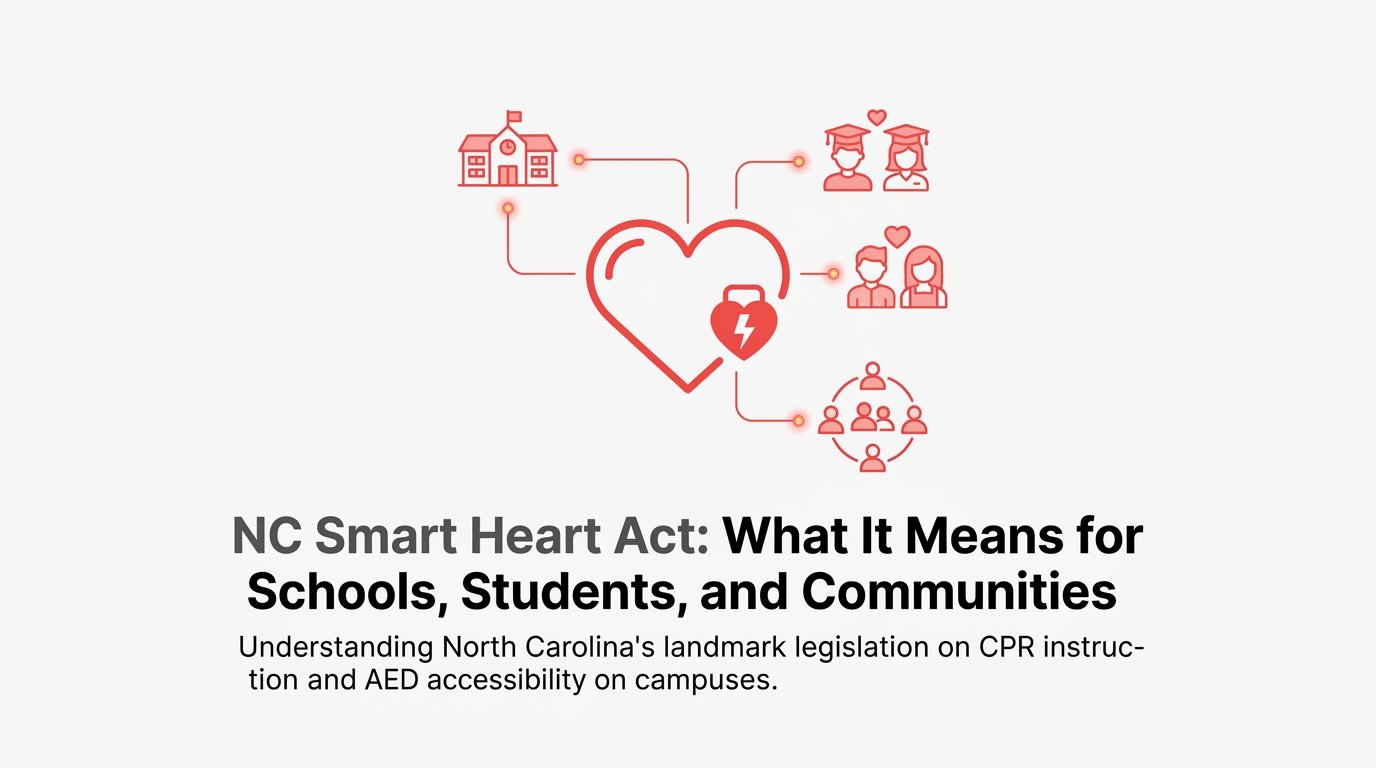
The NC Smart Heart Act is North Carolina's legislative commitment to equipping students, educators, and school staff with the knowledge and tools needed to respond to cardiac emergencies before paramedics arrive. At its core, the law addresses two interconnected needs: making sure students receive CPR instruction as part of their education, and ensuring that automated external defibrillators are available and ready on school campuses.
If you are a parent wondering what your child is learning in health class, a school administrator trying to understand your compliance obligations, a coach who wants to be prepared for an emergency on the field, or a healthcare professional supporting a school's safety planning, this article is for you. We will walk through what the law actually requires, why those requirements matter, how schools can meet them practically, and how organizations like Best Emergency Services Training can make the process straightforward for schools and districts of any size.
The Law at a Glance: Core Requirements of the NC Smart Heart Act
The NC Smart Heart Act is North Carolina legislation embedded within the state's general statutes governing public schools, including provisions related to G.S. 115C-81.65. The law establishes requirements for CPR instruction and AED access in public school settings, and it represents a significant step toward building cardiac emergency readiness into the fabric of student education.
Because legislative details can be updated or amended, anyone responsible for school compliance should verify the current statutory language directly through the North Carolina General Assembly at ncleg.gov. What follows reflects the general framework of the law as it has been widely understood and implemented.
CPR Instruction Requirements
The Act requires that students in North Carolina public schools receive instruction in cardiopulmonary resuscitation. This instruction is generally mandated at the high school level, with the goal of ensuring that students graduate with at least a foundational understanding of how to respond to a cardiac emergency.
The training required under the Act is typically structured around hands-only CPR, which focuses on chest compressions without rescue breaths. This approach is widely endorsed by the American Heart Association as an effective and accessible form of bystander response, particularly for untrained or minimally trained individuals. The instruction does not necessarily require students to obtain a formal certification card, but it does require meaningful, skills-based learning rather than a simple classroom lecture.
The law specifies that CPR instruction should be integrated into existing coursework, most commonly physical education or health classes, making it practical to deliver without requiring a separate standalone course. Schools are expected to use instructional programs that align with evidence-based guidelines, which in practice often means materials or curricula developed or endorsed by organizations like the American Heart Association.
AED-Related Provisions
The NC Smart Heart Act also addresses the presence of automated external defibrillators on school campuses. Public schools are required to have AEDs available on school grounds, and the law includes expectations around ensuring that staff members are trained to use them.
AED placement requirements are intended to ensure that a device can be retrieved and deployed quickly during an emergency. The specifics around the number of devices required, their placement locations, and inspection schedules should be confirmed against current statutory language, as these details carry real compliance weight for school administrators. What is clear across the law's intent is that an AED on the wall is only useful if someone knows how to use it and can reach it in time.
Why Cardiac Emergencies in Schools Demand a Legislative Response
It might seem counterintuitive to associate cardiac arrest with young, apparently healthy people. Most of us picture cardiac emergencies as something that happens to older adults. But sudden cardiac arrest in young people, including student athletes, is a documented reality that the medical community takes seriously.
Physical activity, while overwhelmingly beneficial, can in rare cases trigger a cardiac event in individuals with underlying conditions that may have gone undetected. During athletic practice, a game, or even a physical education class, a student can collapse without warning. The setting, a school gym, a sports field, a hallway, means that the people first on the scene are almost always teachers, coaches, students, and staff, not paramedics.
The Critical Window Before EMS Arrives
Emergency medical services are skilled and equipped, but they cannot be everywhere at once. In many communities, response times can range from several minutes to longer depending on geography and call volume. During a cardiac arrest, brain damage can begin within minutes of the heart stopping. The actions taken in those first few minutes by bystanders on the scene are widely recognized by medical authorities as a critical factor in whether someone survives.
Bystander CPR, meaning chest compressions started by someone who is present before EMS arrives, helps maintain blood flow to the brain and vital organs. The American Heart Association and other leading medical organizations consistently emphasize that immediate bystander response significantly improves the odds of survival from sudden cardiac arrest. The gap between when a cardiac arrest occurs and when professional help arrives is precisely where trained bystanders make the difference.
Schools as the Right Place to Build This Skill
Schools represent one of the most efficient and equitable places to build CPR knowledge across a population. When students learn CPR as part of their education, that knowledge does not stay in the classroom. It goes home with them, into their communities, and stays with them for years. A teenager who learns hands-only CPR in tenth grade physical education class may be the person who saves a parent's life a decade later.
The NC Smart Heart Act addresses the gap between cardiac arrest occurrence and professional response by making CPR instruction a standard part of what North Carolina students learn before they graduate. It treats this life-saving skill the same way it treats reading or mathematics: as something every student deserves the opportunity to learn.
What Schools Must Actually Do to Stay Compliant
Understanding the spirit of a law is one thing. Knowing exactly what your school needs to do to meet its requirements is another. For school administrators, compliance with the NC Smart Heart Act involves several distinct areas of responsibility, and getting each one right requires coordination across departments.
Integrating CPR Instruction into the Curriculum
The most visible compliance requirement is ensuring that CPR instruction is delivered to students at the required grade levels. In practice, this typically means working with physical education teachers and health educators to incorporate hands-only CPR training into existing course content.
The instruction needs to be skills-based, not just informational. Students should have the opportunity to practice chest compressions, typically on a manikin or training device, rather than simply watching a video or reading a handout. Many schools use CPR training kits that include individual manikins or inflatable training devices, which allow entire classes to practice simultaneously without requiring a large budget.
Physical education teachers are often the primary instructors for this content, and many have pursued or can pursue training to deliver CPR instruction effectively. Some schools partner with external training organizations to bring certified instructors into the school for dedicated training sessions, which can be especially useful when launching a new program or refreshing an existing one.
AED Placement and Accessibility
Compliance on the AED side requires schools to have devices on campus and to ensure they are accessible, maintained, and functional. This means more than simply purchasing an AED and mounting it on a wall. Administrators need to think through where devices are placed relative to where emergencies are most likely to occur, such as gymnasiums, athletic fields, and cafeterias, and whether someone could realistically retrieve a device within the first few minutes of a cardiac event.
AEDs require regular inspection and maintenance. Batteries and electrode pads have expiration dates and must be replaced on schedule. Schools should establish a clear maintenance protocol, assign responsibility for routine checks, and keep records of inspections. Letting an AED sit unmonitored is a compliance and safety risk.
Staff Training Obligations
Having an AED on campus is only part of the equation. The law's intent is that staff members know how to use it. Schools should ensure that a meaningful number of staff, particularly those in roles where they are likely to be first on the scene during an emergency, have received AED training and CPR instruction.
Common compliance questions include how often training must be renewed, what training formats are acceptable, and what documentation schools should maintain. Administrators should consult the current statutory language and any guidance issued by the North Carolina Department of Public Instruction to get precise answers to these questions, as requirements can evolve.
CPR Training Options That Satisfy the Act's Requirements
Not all CPR training is the same, and understanding the difference between student-level instruction and professional-grade certification helps schools make smart decisions about who needs what kind of training.
Student-Level Instruction
For students, the NC Smart Heart Act calls for instruction in CPR skills, with hands-only CPR being the most common format used in school settings. This type of training focuses on recognizing cardiac arrest, calling for help, and performing chest compressions. It does not require students to obtain a certification card, and it is designed to be delivered efficiently within a class period or a series of class sessions.
The American Heart Association offers curricula specifically designed for school settings, including programs that can be facilitated by trained teachers using provided materials. These programs are widely used in North Carolina schools and align well with what the Act envisions for student instruction.
Professional-Grade Certification for Staff
For school nurses, coaches, athletic trainers, and other staff members who may be first responders in an emergency, a higher level of training is appropriate and in many cases expected. Basic Life Support (BLS) certification, offered through the American Heart Association, provides a more comprehensive skill set that includes full CPR with rescue breaths, AED use, and relief of choking in adults, children, and infants.
BLS is the standard certification for healthcare providers and is widely recognized as the appropriate credential for school health professionals and athletic staff. Heartsaver CPR/AED courses, also from the American Heart Association, are designed for non-healthcare staff who want a thorough, certification-level course that goes beyond basic awareness training.
How Best Emergency Services Training Supports Schools
One of the most practical challenges schools face is logistics. Getting dozens or hundreds of staff members trained without disrupting the school day is not simple. This is where onsite group training becomes especially valuable.
Best Emergency Services Training offers American Heart Association-aligned courses including BLS, CPR/AED, and Heartsaver programs, and brings instruction directly to schools and organizations through onsite group training. Rather than sending staff to an offsite location, a certified instructor comes to your school, works around your schedule, and delivers training in a format that works for your team. This approach makes it realistic for schools to train large groups efficiently, whether that means an entire staff during a professional development day or a smaller group of coaches and athletic trainers before a sports season begins.
AEDs in Schools: More Than Just a Box on the Wall
An automated external defibrillator is a remarkable piece of technology. It is designed to be used by people with minimal training, provides clear voice-guided instructions, and can deliver a life-saving shock to restore a normal heart rhythm in cases of certain cardiac arrest rhythms. But the device can only do its job if it is accessible, functional, and in the hands of someone who is not paralyzed by uncertainty when a crisis unfolds.
The Human Factor in AED Effectiveness
Even though AEDs are designed for layperson use, training matters. Someone who has practiced with an AED, even in a simulated scenario, will respond faster and more confidently than someone encountering the device for the first time during an emergency. Training removes hesitation, and in a cardiac emergency, hesitation costs time.
Schools should ensure that staff members who are likely to be near an AED during school hours, including front office staff, custodians, coaches, and teachers, have received hands-on AED training as part of their CPR instruction. The goal is to have multiple trained individuals in every building, not just one or two designated responders.
Maintenance Is Not Optional
An AED that has a dead battery or expired electrode pads is not a safety asset. It is a false sense of security. Schools must establish a regular inspection schedule, typically monthly at minimum, to verify that each device is functioning, that consumable components are within their expiration dates, and that the device is stored in its designated location and accessible.
Assign specific staff members to be responsible for AED checks and keep a written log of each inspection. This documentation is important both for compliance purposes and for ensuring that no inspection gets skipped during a busy school year.
Building a Culture of Preparedness
Compliance with the NC Smart Heart Act should be the floor, not the ceiling. Schools that take cardiac emergency preparedness seriously go beyond checking boxes. They conduct regular drills, post clear signage indicating AED locations, and ensure that new staff members receive orientation that includes AED awareness. When the entire school community understands where the AEDs are and who is trained to use them, response times improve and outcomes improve with them.
Building a Heart-Safe School Community Beyond the Minimum
The NC Smart Heart Act establishes a baseline. What schools do beyond that baseline is where real culture change happens. Schools that treat cardiac emergency preparedness as an ongoing commitment rather than an annual compliance task build environments where staff feel confident, students feel safe, and the community benefits from a broader network of trained responders.
Expanding Training to Coaches, Volunteers, and Support Staff
Athletic coaches are often the adults closest to student athletes during the moments of highest cardiac risk. Ensuring that every coach, not just the athletic director or head coach, has current CPR and AED certification is a meaningful step beyond minimum compliance. The same applies to volunteers who support school events, parent chaperones on field trips, and after-school program staff.
Best Emergency Services Training makes this kind of broad-based training practical through flexible onsite group training options. A school district can bring training to multiple schools in sequence, or schedule a single large training session for all athletic staff before the school year begins. The flexibility to train around existing schedules, rather than requiring staff to travel to an offsite facility, removes one of the biggest barriers to getting more people trained.
Extending the Safety Net into the Community
A heart-safe school community does not end at the school building's front door. Parents, local youth sports coaches, and community organization leaders who interact with students regularly are part of the same safety network. When more community members are trained in CPR and AED use, the protective circle around students grows wider.
Schools can play a role in encouraging community training by sharing information about local CPR training resources, hosting community training events, or partnering with organizations like Best Emergency Services Training to offer accessible courses for parents and community members. Even a single training session offered to parents during a school event can add dozens of trained bystanders to a community.
Making Training a Recurring Commitment
CPR skills, like any skill, benefit from practice and renewal. The American Heart Association recommends that certifications be renewed every two years, and many healthcare employers require it. Schools should build CPR and AED training into their annual professional development calendar rather than treating it as a one-time event. Consistent renewal ensures that skills stay sharp and that new staff members are brought up to the same standard as veterans.
Putting It All Together: A Safer Future Starts in the Classroom
The NC Smart Heart Act is more than a compliance requirement. It is a recognition that the skills needed to save a life should not be reserved for healthcare professionals. When students graduate from North Carolina's public schools knowing how to perform CPR and when staff members are trained and equipped to use an AED, the entire community becomes safer.
For school administrators, the path forward involves integrating CPR instruction into existing curricula, ensuring AEDs are properly placed and maintained, and confirming that staff have the training they need to respond confidently in an emergency. These are achievable goals, and the resources to meet them are available.
For coaches, school nurses, and athletic trainers, pursuing BLS or Heartsaver certification through a trusted provider ensures you have the professional-grade skills your role demands. For parents and community members, taking a CPR course extends the safety net beyond the school building and into everyday life.
Best Emergency Services Training is ready to help schools, districts, and community organizations meet and exceed the requirements of the NC Smart Heart Act. With American Heart Association-aligned courses including BLS, CPR/AED, and Heartsaver, plus the convenience of onsite group training that comes directly to your location, getting your team trained has never been more straightforward. Flexible scheduling means training can fit around school calendars, professional development days, and athletic seasons without disruption.
Do not let compliance deadlines or logistics stand between your school community and the training it needs. Schedule your personalized training session today and connect with the instructors at Best Emergency Services Training to build a heart-safe school environment that goes beyond the minimum and puts real life-saving skills in the hands of the people who need them most.