Sudden cardiac arrest does not wait for a convenient moment. It can happen to a student during gym class, to a teacher in the middle of a lesson, or to a coach on the sideline. When it does, the minutes before emergency services arrive are the most critical window for survival. The people nearby, whether they are other students, staff members, or administrators, are often the only ones in a position to act.
North Carolina recognized this reality and took meaningful legislative action. Senate Bill 278 established requirements for CPR instruction in public schools, ensuring that students graduate with at least a foundational understanding of how to respond when someone's heart stops. It is one of the most practical steps a state can take to improve community-wide emergency preparedness, starting with the next generation.
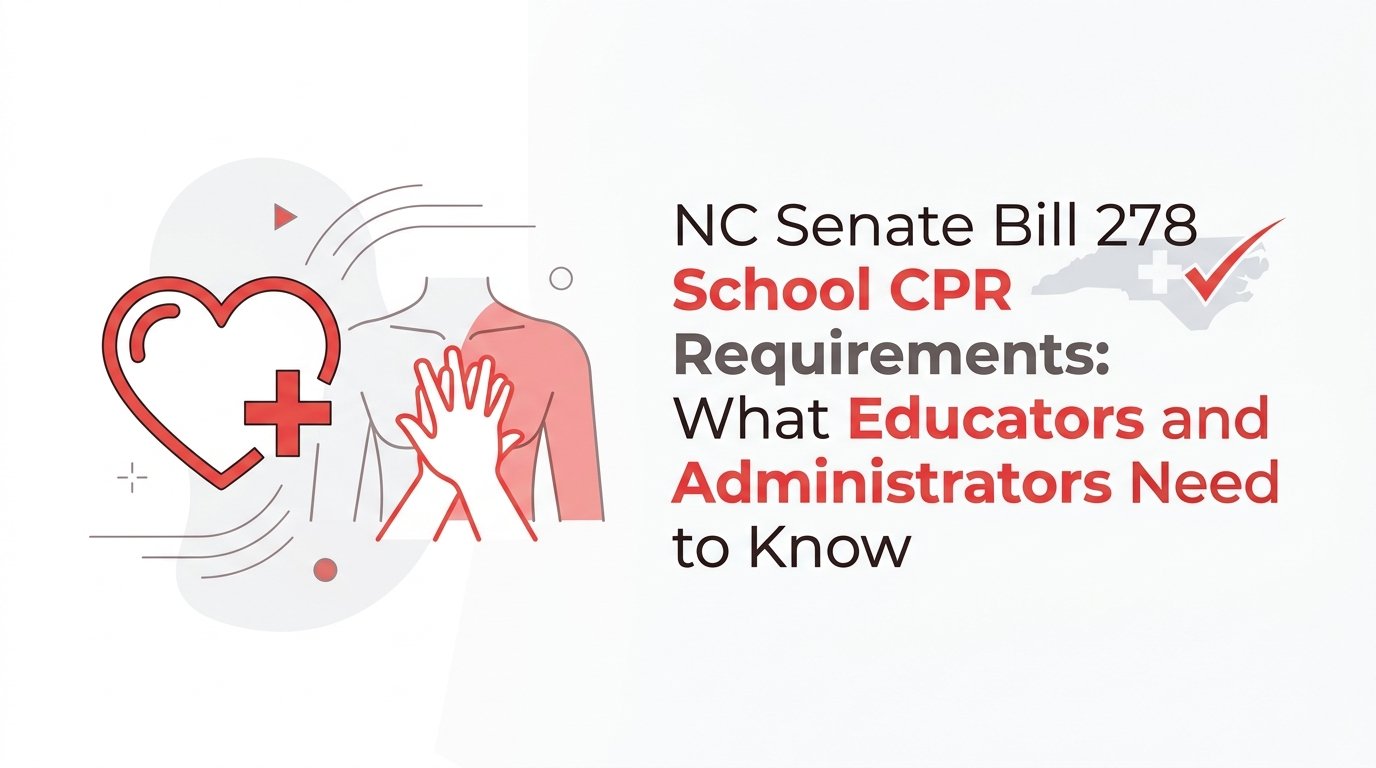
If you are a school administrator, educator, coach, or district leader trying to understand what NC Senate Bill 278 school CPR requirements mean for your institution, this guide is written for you. We will break down the legislative background, clarify what the law actually requires, explore how schools are putting it into practice, and explain how professional training partnerships can help your school go beyond minimum compliance to build genuine readiness.
Understanding the law is the first step. Knowing how to act on it is what makes the difference when every second counts.
The Legislative Background Behind Senate Bill 278
North Carolina Senate Bill 278 reflects a growing national recognition that CPR training should not be limited to healthcare professionals. When bystanders know how to respond to sudden cardiac arrest, outcomes improve significantly. Legislatures across the country have moved to embed that knowledge into public education, and North Carolina is among them.
Senate Bill 278 established requirements for CPR instruction within North Carolina public schools, with the legislative intent of ensuring that students enter adulthood equipped with a skill that can save lives. The bill was designed to make CPR training a standard part of the educational experience rather than an optional add-on or a one-time health class activity.
It is important to understand how this bill fits within a broader legislative framework. North Carolina's Smart Heart Act is a related piece of legislation that addresses automated external defibrillator (AED) placement and maintenance requirements in schools. The two laws work in tandem. Senate Bill 278 focuses on building the human skill of CPR, while the Smart Heart Act ensures that the equipment needed to support that response, specifically AEDs, is present and accessible on school grounds. Together, they create a more comprehensive approach to cardiac emergency preparedness in educational settings.
In terms of scope, the requirements under Senate Bill 278 apply to students in North Carolina public schools. The bill targets instruction at the high school level, with the intent that students receive CPR training before graduation. Some guidance has also addressed middle school instruction as part of a broader effort to introduce these skills earlier, though the specific grade-level requirements and frequency of training should be confirmed through the official NC General Assembly website or current NC Department of Public Instruction guidance, as legislative details and implementation rules can be updated over time.
What the bill does not do is require every student to walk away with a formal American Heart Association certification card. The focus is on instruction and skill exposure, not credentialing. That distinction matters for how schools plan and budget for compliance, and we will explore it in more detail in the next section.
The legislative intent behind Senate Bill 278 is clear: North Carolina wants its graduates to know what to do when someone collapses. That is a modest but genuinely impactful goal, and it reflects a broader commitment to community health that goes well beyond the classroom.
What the Law Actually Requires of Schools
One of the most common points of confusion around NC Senate Bill 278 school CPR requirements is the difference between instruction and certification. Schools are not required to certify every student through a formal American Heart Association program. The law focuses on ensuring that students receive CPR instruction, meaning they are taught the skills and concepts involved in performing CPR, particularly hands-only CPR.
Hands-only CPR, which involves chest compressions without rescue breaths, is the technique most commonly emphasized in school-based instruction. It is effective, easier to learn quickly, and appropriate for lay responders who encounter an adult in sudden cardiac arrest. The American Heart Association has supported the use of hands-only CPR as a practical and accessible starting point for bystander response, and it aligns well with the instructional goals of a school-based program.
Under the bill's framework, students are expected to receive this instruction at least once before graduating from high school. Many schools and districts have interpreted the spirit of the law to include instruction at both the middle school and high school levels, providing students with multiple exposures to the skills over the course of their education. Writers and administrators should verify the current frequency and grade-level specifics through the NC Department of Public Instruction, as implementation guidance can evolve.
The question of who delivers the training is also important. The law does not necessarily require that CPR instruction be delivered by a certified AHA instructor, though having qualified instructors improves the quality and credibility of the training. Many schools rely on health or physical education teachers who have received some level of CPR training themselves. Others bring in outside certified instructors to ensure that the instruction meets a higher standard.
There is no blanket requirement under Senate Bill 278 that all school staff hold current CPR certifications, though many districts have policies or contractual requirements that address staff certification separately. Coaches, nurses, and other personnel who work in higher-risk environments are often expected to maintain current certifications regardless of what the bill requires for student instruction.
The practical takeaway for administrators is this: the law sets a floor, not a ceiling. Meeting the minimum requirement means ensuring students receive CPR instruction before graduation. Going above that minimum, by training staff to full AHA certification standards and creating a school-wide culture of preparedness, is both achievable and advisable. Many schools find that the minimum requirement is a useful starting point, but the real value comes from building on it.
How Schools Are Meeting the Requirement in Practice
When it comes to implementation, schools across North Carolina have taken a variety of approaches to meet the CPR instruction requirements under Senate Bill 278. The most common path is integration into existing health or physical education curricula, where CPR instruction becomes a unit within a course that students are already required to complete.
This approach has practical advantages. It does not require carving out separate time in an already packed school schedule, and it allows CPR instruction to be contextualized alongside other health and wellness content. A physical education teacher who walks students through hands-only CPR technique during a health unit can cover the instructional requirement without a major logistical overhaul.
That said, there is a meaningful difference between awareness training and skills training, and an even larger gap between skills training and full certification. Awareness training might involve watching a video or listening to a presentation. Skills training involves hands-on practice with manikins, feedback on technique, and the opportunity to repeat compressions until the motion becomes more intuitive. Full certification, such as an AHA Heartsaver CPR AED course, adds formal assessment and produces a credential that is recognized by employers and healthcare systems.
The bill's requirements fall into the skills instruction category. Students are expected to practice, not just observe. That means schools need access to CPR training manikins, which represent a real logistical and budgetary consideration. A school training an entire grade level needs enough manikins to allow meaningful hands-on practice rather than one demonstration manikin shared among thirty students.
Scheduling is another practical challenge. Coordinating CPR instruction for large groups of students requires planning around class schedules, gym availability, equipment setup, and instructor time. Schools that have built CPR instruction into a recurring health curriculum unit tend to manage this more smoothly than those trying to organize it as a standalone event.
Some districts have addressed these challenges by partnering with professional CPR training providers who bring equipment, instructors, and a structured curriculum directly to the school. This takes the logistical burden off school staff and ensures that the instruction meets a consistent quality standard. Many schools find that this model simplifies compliance while also giving students a better learning experience than an improvised in-house session might provide.
The key is that compliance is genuinely achievable with thoughtful planning. Schools that approach CPR instruction as a recurring, integrated part of their health curriculum, rather than a one-time event to check off a list, tend to build more durable programs that serve students well.
The Role of AEDs and Broader Emergency Preparedness
CPR instruction does not exist in a vacuum. For a school to be truly prepared for a cardiac emergency, the human skill of CPR needs to be paired with accessible equipment and a clear response plan. This is where the connection between Senate Bill 278 and North Carolina's Smart Heart Act becomes especially relevant.
The Smart Heart Act addresses AED placement requirements in North Carolina schools, establishing expectations around where AEDs should be located and how they should be maintained. An AED is a device that can analyze heart rhythm and deliver an electrical shock to restore normal rhythm in cases of certain types of cardiac arrest. When CPR and AED use are combined, the likelihood of a positive outcome improves significantly compared to CPR alone.
For schools, this means that having AEDs on campus is only part of the equation. The devices need to be in known locations, properly maintained, and accessible within the time frame that matters during an emergency. Staff members need to know where the AEDs are and feel confident enough to retrieve and use one without hesitation. That confidence comes from training, not just from the presence of a device on the wall.
Beyond AED access, a whole-school approach to emergency preparedness involves several additional elements. Schools should conduct regular drills that simulate cardiac emergency scenarios, not just fire drills. Staff should know their roles in an emergency response chain, from the first person who recognizes the situation to the person who calls 911 to the person who retrieves the AED. Clear communication protocols and designated response roles reduce confusion in high-stress moments.
Administrators who think beyond minimum legislative compliance and invest in a broader preparedness culture tend to create environments where staff feel capable and confident rather than anxious and unprepared. That shift in culture is not just about liability or legal requirements. It is about creating a school where everyone, from the front office administrator to the after-school coach, knows what to do when it matters most.
Senate Bill 278 and the Smart Heart Act together create a foundation. Building on that foundation with comprehensive staff training, regular equipment checks, and practiced emergency protocols is what transforms a school from compliant to genuinely prepared.
Options for Schools Seeking Certified Instructors and Group Training
While Senate Bill 278 sets the minimum standard for student CPR instruction, many schools and districts choose to go further by ensuring that their staff hold current, formal CPR certifications. This is a smart investment, and it reflects a recognition that the adults in a school building are the first responders in any emergency that occurs during the school day.
Partnering with a professional CPR training provider is one of the most effective ways to achieve this goal. Rather than relying on a single staff member who completed a certification course years ago, a professional provider brings current curriculum, qualified instructors, and the equipment needed to deliver a high-quality training experience. This is particularly valuable for schools that want their staff to hold American Heart Association certifications, such as the Heartsaver CPR AED course, which is widely recognized and accepted across healthcare and non-healthcare settings alike.
Onsite group training is an especially practical option for schools. Instead of sending individual staff members to off-site training locations and managing scheduling across a large team, an onsite session brings the training directly to the school. The instructor arrives with manikins, AED trainers, and course materials. Staff complete their training in a familiar environment without the logistical complexity of coordinating transportation or managing coverage for absent employees.
Group training can also be customized to address the specific needs of different staff groups. Coaches who work in high-exertion environments may benefit from training that emphasizes recognition of sudden cardiac arrest in athletic settings. Administrators and front office staff may focus on their role in the emergency response chain. Nurses and health aides may pursue a higher-level certification that aligns with their professional responsibilities. A good training provider can tailor the session to the audience rather than delivering a one-size-fits-all experience.
Flexible scheduling is another significant advantage of working with a professional provider. Schools operate on tight calendars, and finding time for staff training during the academic year requires creativity. Providers who offer early morning sessions, after-school options, or training during professional development days make it far easier for schools to get their staff certified without disrupting instruction time.
Best Emergency Services Training offers onsite group training designed specifically for organizations like schools that need to train multiple staff members efficiently and effectively. With AHA-aligned curriculum, experienced instructors, and flexible scheduling, Best Emergency Services Training can help schools meet and exceed the requirements of Senate Bill 278 while building a staff that is genuinely prepared to respond in an emergency. Many schools find that partnering with a certified training provider simplifies compliance and improves staff confidence in ways that in-house solutions often cannot match.
Putting It All Together: From Compliance to Confidence
Senate Bill 278 is not a bureaucratic hurdle. It is a practical mandate rooted in a straightforward truth: people who know CPR save lives, and schools are one of the most efficient places to build that knowledge at scale. Every student who learns hands-only CPR before graduating from a North Carolina public school is a potential bystander responder in their community for the rest of their life.
For administrators, the path to compliance is clear. Ensure that students receive CPR instruction before graduation, integrate that instruction into existing health or physical education curricula where possible, secure the equipment needed for hands-on practice, and document your program so that you can demonstrate compliance when needed. Verify the current grade-level and frequency requirements through the NC Department of Public Instruction or the NC General Assembly website, since legislative guidance can be updated.
But compliance is a starting point, not a destination. The schools that create the safest environments are those that view CPR training as an ongoing investment rather than a one-time requirement. That means certifying staff, not just instructing students. It means maintaining AEDs and practicing emergency response drills. It means creating a culture where everyone in the building feels capable of acting when it matters.
If your school or district is ready to take the next step, whether that means scheduling onsite group training for staff, certifying coaches and administrators, or building a more comprehensive emergency preparedness program, Best Emergency Services Training is ready to help. With flexible scheduling, AHA-aligned curriculum, and experienced instructors who come directly to your location, getting your team trained is more straightforward than you might expect.
Schedule your personalized training session today and take the step from compliance to genuine confidence in your school's emergency preparedness.