North Carolina's Smart Heart Act places clear legal responsibilities on public schools to maintain cardiac emergency preparedness. For school administrators, athletic directors, and nurses, understanding exactly what the law requires and how to meet those requirements is not always straightforward.
The Act mandates specific protocols around AED placement, CPR and AED training for staff, and emergency response planning. Falling short of these requirements puts students and staff at risk and exposes the school district to serious liability.
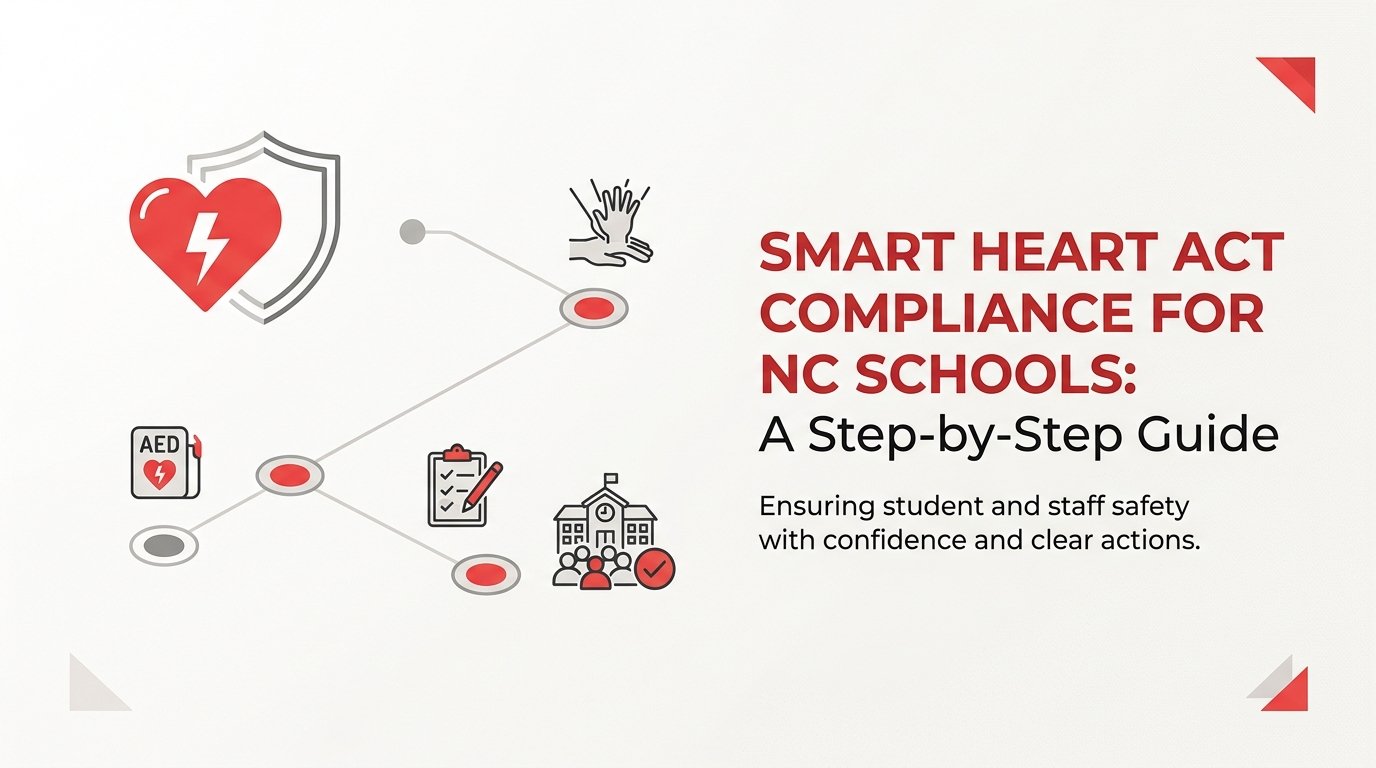
This guide walks through each compliance requirement in a logical, sequential order so that school administrators can move from uncertainty to full compliance with confidence. Whether your school is starting from scratch or auditing an existing program, these steps will help you build a defensible, effective cardiac emergency preparedness plan that meets North Carolina standards.
Best Emergency Services Training works directly with schools and organizations across North Carolina to deliver the certified training that compliance requires. This guide reflects the practical experience gained from helping schools get this right.
Step 1: Understand What the Smart Heart Act Actually Requires
Before your school can achieve compliance, everyone responsible for that compliance needs a clear picture of what the law actually demands. The North Carolina Smart Heart Act, codified under General Statute 115C-47.1 and related provisions, establishes specific obligations for public schools. Reviewing the current statutory language directly from the NC General Assembly website is the right starting point, since amendments can occur and you want to work from the most current version.
At its core, the Act requires that AEDs be available on school grounds and at school-sponsored athletic events. It also mandates that trained personnel be present at those events. This is not a suggestion or a best-practice recommendation. It is a legal requirement with real consequences for non-compliance.
One of the most important distinctions to understand early is that the training requirement extends to practices as well as competitions. This matters because it affects how many trained staff members must be present and when. A school that has certified coaches on hand for game nights but not for Tuesday afternoon practice sessions has a compliance gap that needs to be addressed.
Identify who holds accountability for compliance at your school. Typically this falls to the principal, the athletic director, or the school nurse, but that responsibility should be documented formally rather than assumed informally. When accountability is unclear, things fall through the cracks.
The Act also requires that CPR and AED training come from an approved provider. American Heart Association certification is the recognized standard, and not all training programs meet that bar. This is a common pitfall: a school may have staff who completed some form of first aid training through a program that does not meet AHA standards, and those certifications will not satisfy the Act's requirements.
Finally, keep in mind that compliance is the floor, not the ceiling. Meeting the letter of the law is the minimum. A genuinely effective cardiac emergency program goes further by ensuring that the right people are trained, that AEDs are accessible when and where they are needed, and that everyone knows what to do when seconds count.
Step 2: Conduct a Full Audit of Your Current AED Inventory and Placement
Once you understand what the law requires, the next step is to take an honest look at where your school currently stands. A thorough AED audit gives you a clear baseline and helps you identify gaps before they become liabilities.
Walk every area of your campus with a clipboard or a shared digital document. Record the location of every existing AED, including the model, the age of the device, and the date of the last inspection. This is not a task to delegate to someone working from memory. Physical verification is the only way to catch discrepancies between what is on paper and what is actually on the wall.
Pay particular attention to athletic facilities. Gymnasiums, weight rooms, outdoor fields, and locker rooms are high-risk areas under the Act because they see the most physical exertion. Each of these spaces deserves its own evaluation. An AED mounted near the main office may be perfectly positioned for a cardiac event in the hallway but completely inaccessible during a football practice on the far end of campus.
The standard guidance from cardiac emergency response experts is that a responder should be able to retrieve an AED and reach any point on campus within a few minutes of a cardiac event occurring. Use your audit to map whether your current placement achieves that. If there are areas of the building or grounds where the answer is no, those gaps need to be addressed.
For each device, verify that it is properly maintained. Check that the pads and batteries are within their expiration dates and that the device is passing its self-check indicator. An AED that is present but not functional offers false reassurance and no actual protection.
Also consider events held off campus. School-sponsored athletic events that take place at other facilities still fall under the Act's requirements. Document how your school currently handles AED availability in those situations and whether that approach is sufficient.
Record everything in writing. Your audit creates a baseline that will serve as the foundation for future inspections, district reviews, or, in the worst case, a legal inquiry following an incident. Best Emergency Services Training's resources on AED device selection and placement can provide additional guidance as you work through this process.
Step 3: Identify Which Staff Members Need Certified Training
Knowing that staff need to be trained is one thing. Knowing exactly which staff members need certification, at what level, and by what date is another. This step turns a vague obligation into a specific, manageable list.
Start by reviewing the Act's requirements for trained personnel. The law distinguishes between different roles, and the obligations for coaches, physical education teachers, athletic trainers, and school nurses may differ from those for general classroom staff. Read those distinctions carefully and apply them to your specific staffing situation.
Create a master list of every staff member who is required to hold current CPR and AED certification. This list should include names, roles, and the specific certification level required for each person. Coaches and PE teachers are obvious inclusions, but do not overlook athletic event supervisors, school nurses, and any staff who regularly serve in supervisory roles at athletic events.
Cross-reference that master list against existing certifications. Sort your staff into three categories: currently certified with a valid card, previously certified but expired, and never trained. Each category requires a different response. Currently certified staff need only to be tracked for renewal. Expired certifications need to be renewed before the next athletic event those staff members supervise. Staff who have never been trained need to be scheduled for initial certification as a priority.
Factor in turnover and irregular staffing. New hires who arrive mid-year, substitutes who regularly cover athletic events, and volunteers who serve in supervisory roles may all need training. These are the people most likely to be overlooked in a compliance audit, and they are also the people who could find themselves as the first responder in an emergency.
A common pitfall here is relying on certifications from programs that do not meet American Heart Association standards. A staff member may have completed a first aid course through another provider and genuinely believe they are compliant. It is worth confirming that every certification on your list comes from an AHA-approved course. If it does not, that person needs to complete AHA-certified training regardless of what other credentials they hold.
Step 4: Schedule and Complete AHA-Certified CPR and AED Training
With your training list in hand, the next step is to get everyone certified through a program that actually meets the Act's requirements. This means selecting an American Heart Association certified training provider and choosing the right course level for each staff member.
For most school staff, including coaches, PE teachers, and general supervisory personnel, the Heartsaver CPR AED course is the appropriate choice. This course is designed for lay responders and workplace settings, and it covers the core skills needed to respond to a cardiac emergency: recognizing cardiac arrest, performing CPR, and operating an AED.
School nurses and athletic trainers typically require a higher level of training. BLS for Healthcare Providers is the AHA course designed for clinical professionals, and it is the appropriate standard for staff who hold healthcare credentials or who are expected to provide a more advanced level of emergency response.
When it comes to logistics, onsite group training is often the most practical solution for schools. Bringing a certified instructor to your campus allows multiple staff members to train at the same time without the disruption and travel time involved in sending people to an offsite location. Best Emergency Services Training offers onsite group training specifically designed for organizations including schools, which means administrators can train entire coaching staffs or departments in a single session scheduled around the school calendar.
Confirm that every participant receives a valid AHA certification card upon completing the course. This card is the documentation you will need to demonstrate compliance during a district audit or legal review. A training session that does not result in a recognized certification card does not satisfy the Act's requirements.
Build renewal dates into your school calendar now. AHA certifications are valid for two years, and it is easy to let renewal deadlines slip when they fall in the middle of a busy school year. Setting calendar reminders at the 18-month mark gives you time to schedule renewals before certifications lapse.
A practical tip for athletic staff: coordinate initial training and renewals around pre-season periods. Getting coaches certified before the first practice of each sport season ensures that trained personnel are present from day one, which is exactly what the Act requires.
Step 5: Develop and Post Your Written Emergency Action Plan
Training staff and placing AEDs on campus are essential, but they are not sufficient on their own. The Smart Heart Act requires schools to have a written Emergency Action Plan that outlines the specific steps staff should take when a cardiac emergency occurs. A plan that exists only in someone's head is not a plan at all.
Your Emergency Action Plan should answer five questions clearly: Who calls 911? Who retrieves the AED? Who begins CPR? Who meets emergency services at the entrance to guide them to the scene? Who notifies school administration? When every person on campus knows their role in advance, the response to a cardiac emergency is faster and more coordinated.
The National Athletic Trainers' Association has published position statements on emergency action plans for athletic settings that are widely referenced by school athletic programs. These documents offer a strong framework for structuring your plan and are worth reviewing as you draft your own.
Create a separate EAP for each athletic venue and high-risk location on your campus. The gymnasium, the football field, the weight room, and the aquatic facility each have different layouts, different staffing patterns, and different AED locations. A generic plan that does not account for these differences is significantly less useful in an actual emergency. Location-specific plans remove ambiguity and allow staff to respond without having to think through logistics under pressure.
Post the EAP in a visible location near each AED. The goal is to make the plan accessible to any staff member who happens to be present during an emergency, not just the people who wrote it. A laminated card mounted next to the AED cabinet is a simple, effective approach.
Review the EAP with all relevant staff at the start of each school year and after any changes to facilities, staffing, or AED placement. A plan that was accurate last year may have gaps this year if the AED was moved, a key staff member left, or a new facility was added.
Consider running a tabletop drill or a walkthrough with staff before the school year begins. Walking through the plan in a low-stakes environment reveals gaps that are not visible on paper and builds the muscle memory that makes real responses faster and more effective.
Step 6: Register Your AEDs and Maintain Compliance Documentation
The final operational step in achieving Smart Heart Act compliance is one that many schools overlook: AED registration and ongoing documentation. Having AEDs on campus and trained staff to use them is not enough if the paperwork does not support it.
North Carolina law requires AEDs to be registered with local emergency medical services. This registration ensures that dispatchers know about the device locations in the event of a 911 call, which can help direct responders more effectively. Contact your county EMS agency to complete the registration process for each device on campus. The specific process may vary by jurisdiction, so reaching out directly to your local agency is the right approach.
Once registration is complete, build a compliance documentation system that will hold up to scrutiny. Whether you use a physical binder or a digital file, it should contain the following: AED registration records for every device, inspection and maintenance logs with dates and findings, staff certification cards or copies thereof, and copies of every Emergency Action Plan your school has developed.
Document every training session formally. A training roster that includes participant names, the course completed, the date of training, and the certification expiration date creates a clear record that your school is meeting its obligations. This documentation is what you will produce during a district audit, an insurance review, or a legal inquiry following an incident.
Set calendar reminders for every maintenance-related deadline: AED inspection dates, pad and battery expiration dates, and staff certification renewal dates. These reminders should be owned by a specific person, not left to a shared calendar that no one monitors consistently.
Assign a single point of contact to own the compliance documentation. The school nurse or athletic director is typically the right choice. When one person is responsible for keeping records organized and current, things stay current. When responsibility is diffuse, records drift.
This documentation system is not just a legal protection. It is also a practical management tool that tells you at a glance where your school stands at any point in the year.
Putting It All Together: Keeping Your School Compliant Year After Year
Smart Heart Act compliance is not a one-time project. It is an annual cycle that requires a designated owner, a consistent schedule, and a commitment to keeping records current.
Use this checklist as your annual review framework:
AED Audit: Walk the campus and verify device locations, condition, and maintenance status for every AED.
Staff Training List Review: Update your master list to reflect new hires, departures, and role changes. Identify who needs initial certification and whose renewal is coming due.
Training Completion: Schedule and complete AHA-certified CPR and AED training for all staff on the list before the start of the athletic season.
EAP Update: Review and revise every Emergency Action Plan to reflect any changes to facilities, staffing, or AED placement.
AED Registration: Confirm that every device on campus is registered with your county EMS agency and that registration records are current.
Documentation Review: Audit your compliance binder or digital file to confirm that all records are complete, accurate, and up to date.
Running through this cycle at the start of each school year, with a mid-year check-in before spring athletic seasons begin, keeps your school in a defensible position throughout the year.
Best Emergency Services Training is available to support schools through this process with onsite group training, flexible scheduling, and AHA-certified instruction that meets the requirements of the Smart Heart Act. Whether you need to train a single department or an entire coaching staff, the team at Best Emergency Services Training can work around your school calendar to make it happen.
The resources page and AED guidance on the Best Emergency Services Training website offer additional support for schools working through device selection, placement standards, and training logistics. Schedule your personalized training session today and take the next step toward a fully compliant, genuinely effective cardiac emergency preparedness program for your school.